#1 · Aug 25, 2008 20:20 UTC
The Peavey Classic 50 is quite a schematic to rummage through. Personally, I love Peavey for two reasons: 1) Reliability and 2) Price. They do an awesome job in both of those areas. Some of their designs are, well, interesting. I can't say "bad" or "wrong" as those are relatively subjective. Peavey amps last through the worst of events and still run... that's a pretty damn solid design, if you ask me.
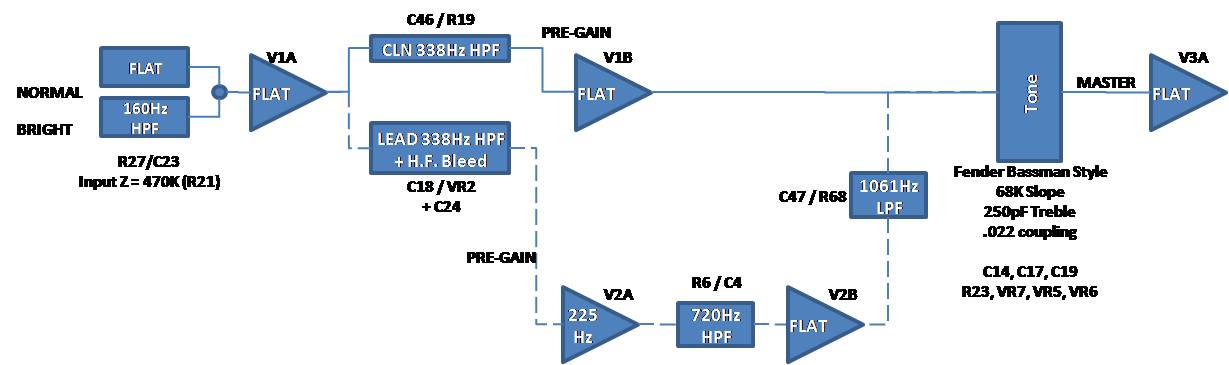
That said, the Classic 50, next to the 5150 schematic, is one of the "worst" to read. But, I think, I've deciphered it, overall. I have presented a JPG outline of the amp, with most of the component parts (if you choose to try to dig up the schematic) that supply the function of each block in this diagram.
The gain structure of the amp varies, quite a bit, from a Marshall topology and follows, more, the SOVTEK type of topology. The "FLAT" gain stages, in this amp, are heavily bypassed for maximum gain, whereas the Marshall gain stages weren't bypassed and the stage gains were much lower. There are more gain stages, per channel (Clean and Lead) than either Marshall or Fender topologies have, including a post-tone-control gain stage.
Some other elements unique to Peavey.
1) Low input impedance (470K, in this case). Not uncommon, but less common than most guitar amps.
2) The "Bright" input has an RC filter network that filters the guitar signal BEFORE any preamp stages, at 160Hz (approximately, 1 octave above Low-E).
3) The "Lead" channel has a combination of 338Hz and 720Hz "high pass filters). This is different from the Marshall topology which has dual 720Hz filters. This allows a bit more low-end into the distortion and adds a bit more "girth". However, by the same token, it can also add some "mush" to guitars that are overly bass-heavy in their output.
4) The "Gain" control on the "Lead" channel has a capacitor which bleeds high frequencies to ground, as the Gain is turned up. This is similar to the MESA DR design, which does the same thing. The more gain the more high frequency content from the guitar is removed. This compensates the added harmonics, generated by the distortion, and "warms up" the sound, some... or at least keeps it more "balanced".
5) The 2nd distortion stage has a 225Hz high pass filter on the cathode, this follows the 338Hz filter feeding the stage. Together, these two filters form a 12dB / octave cut below 225Hz, shelving out most of the "mudrange" that typically causes intermodulation. This steep filter is nowhere near as high up in the frequency range as the Marshall providing less "crunch" even in the face of more extreme gain settings.
7) A bit of "Marshall voicing" is added to a more "warm" distortion texture through R6/C4, coupling stage 2 and stage 3. This is the standard Marshall 720Hz high pass filter, here.
8) V2B is another flat, high gain, stage which distorts the signal even more and this feeds into a 1060Hz low pass filter (shelving high frequencies above 1060Hz). This network has a lot of resistance in it, so most of the signal, above this level, goes into the tone stack, but some of it is bled off, taking some of the "fizz" out. Again, this is a bit of MESA Boogie engineering, as MESA also loves to shelve out signal. Another interesting point to note, here, is that MESA uses this SAME network to feed the tone stack on the Dual Rectifier and Triple Rectifier. However, unlike Peavey, MESA Boogie, makes this bleed adjustable, and calls it the "Presence" control. Peavey fixes the value and it can't be adjusted.
9) The tone stack is mixture of Fender and Marshall... the slope resistor is a higher value than Marshall, lower than Fender providing a bit more bass response than the Fender, a bit less than the Marshall. Given the interstage shelving isn't as strong in the bass region as the Marshall, the end-result would be about the same. The rest of the tone stack is pretty much Fender-esque values, ala the Bassman 5F6-A.
10) One final stage of gain is added prior to the power stage and feedback is sent to this stage, rather than the splitter. This makes this stage ultra-linear. If distortion occurs, here, it's NASSSSSTTTY!
This topology, with the "Gain" control all the way at the front makes for easier "control" over the amount of gain the entire preamp will eventually produce. Unlike the Marshalls, within which the primary component of the distortion is generated in the very last stage of the preamp, this preamp provides generous amounts of distortion at each stage along the way . That is a difference and the end result of the distortion is a more "smooth" and, at more "extreme" gain settings, a potentially more "buzzy", or "fizzy" distortion as there is considerably more symmetry in distorting across multiple stages than what there is generating distortion, primarily, in a single stage.
Overall, never having heard this amp, I would say that there's a bit of a "Marshall" voice in this, in that when driven a bit you'll end up with a bit of "sizzle", but it leans a bit more toward the "warm" side, with a smoother tone/texture than what a Marshall would have. Great for blues, roots rock, etc.
Finally, and this isn't illustrated here, the power amp is moderately damped (some negative feedback, but not a ton) with a segment of Peavey's "resonance" controls installed to add to the cabinet resonance (R64 / C44). This RC combination "decouples" the feedback circuit at lower frequencies allowing the cabinet sound to be slightly more dominant than what a Marshall would. This could have the tendency to make the amp sound a bit "woofy" it were cranked up with some thundering detuned power chords being pumped out. Removing that cap would "tighten" the bass response considerably.
Ultimately, that's about. Most Peavey amps have this "Classic" topology in them. Some don't bleed the high frequencies, like the Classic 50 does, but most of them have a 300-ish Hertz filter, followed by a 720Hz filter, with almost the same tone-stack as this one has. That's Peavey's signature sound, a bit more low-end, more consistent distortion generation across multiple stages of the preamp (similar to MESA). Rather than heavily shelving below 720Hz, Peavey shelves at 350Hz first, generates some distortion, then shelves at 720Hz and generates a lot more. This will, in the end, "thicken" the sound.
Ultimately the Peavey voice hovers somewhere between a high-gain Fender Bassman and a Marshall...
Dar
That said, the Classic 50, next to the 5150 schematic, is one of the "worst" to read. But, I think, I've deciphered it, overall. I have presented a JPG outline of the amp, with most of the component parts (if you choose to try to dig up the schematic) that supply the function of each block in this diagram.
The gain structure of the amp varies, quite a bit, from a Marshall topology and follows, more, the SOVTEK type of topology. The "FLAT" gain stages, in this amp, are heavily bypassed for maximum gain, whereas the Marshall gain stages weren't bypassed and the stage gains were much lower. There are more gain stages, per channel (Clean and Lead) than either Marshall or Fender topologies have, including a post-tone-control gain stage.
Some other elements unique to Peavey.
1) Low input impedance (470K, in this case). Not uncommon, but less common than most guitar amps.
2) The "Bright" input has an RC filter network that filters the guitar signal BEFORE any preamp stages, at 160Hz (approximately, 1 octave above Low-E).
3) The "Lead" channel has a combination of 338Hz and 720Hz "high pass filters). This is different from the Marshall topology which has dual 720Hz filters. This allows a bit more low-end into the distortion and adds a bit more "girth". However, by the same token, it can also add some "mush" to guitars that are overly bass-heavy in their output.
4) The "Gain" control on the "Lead" channel has a capacitor which bleeds high frequencies to ground, as the Gain is turned up. This is similar to the MESA DR design, which does the same thing. The more gain the more high frequency content from the guitar is removed. This compensates the added harmonics, generated by the distortion, and "warms up" the sound, some... or at least keeps it more "balanced".
5) The 2nd distortion stage has a 225Hz high pass filter on the cathode, this follows the 338Hz filter feeding the stage. Together, these two filters form a 12dB / octave cut below 225Hz, shelving out most of the "mudrange" that typically causes intermodulation. This steep filter is nowhere near as high up in the frequency range as the Marshall providing less "crunch" even in the face of more extreme gain settings.
7) A bit of "Marshall voicing" is added to a more "warm" distortion texture through R6/C4, coupling stage 2 and stage 3. This is the standard Marshall 720Hz high pass filter, here.
8) V2B is another flat, high gain, stage which distorts the signal even more and this feeds into a 1060Hz low pass filter (shelving high frequencies above 1060Hz). This network has a lot of resistance in it, so most of the signal, above this level, goes into the tone stack, but some of it is bled off, taking some of the "fizz" out. Again, this is a bit of MESA Boogie engineering, as MESA also loves to shelve out signal. Another interesting point to note, here, is that MESA uses this SAME network to feed the tone stack on the Dual Rectifier and Triple Rectifier. However, unlike Peavey, MESA Boogie, makes this bleed adjustable, and calls it the "Presence" control. Peavey fixes the value and it can't be adjusted.
9) The tone stack is mixture of Fender and Marshall... the slope resistor is a higher value than Marshall, lower than Fender providing a bit more bass response than the Fender, a bit less than the Marshall. Given the interstage shelving isn't as strong in the bass region as the Marshall, the end-result would be about the same. The rest of the tone stack is pretty much Fender-esque values, ala the Bassman 5F6-A.
10) One final stage of gain is added prior to the power stage and feedback is sent to this stage, rather than the splitter. This makes this stage ultra-linear. If distortion occurs, here, it's NASSSSSTTTY!
This topology, with the "Gain" control all the way at the front makes for easier "control" over the amount of gain the entire preamp will eventually produce. Unlike the Marshalls, within which the primary component of the distortion is generated in the very last stage of the preamp, this preamp provides generous amounts of distortion at each stage along the way . That is a difference and the end result of the distortion is a more "smooth" and, at more "extreme" gain settings, a potentially more "buzzy", or "fizzy" distortion as there is considerably more symmetry in distorting across multiple stages than what there is generating distortion, primarily, in a single stage.
Overall, never having heard this amp, I would say that there's a bit of a "Marshall" voice in this, in that when driven a bit you'll end up with a bit of "sizzle", but it leans a bit more toward the "warm" side, with a smoother tone/texture than what a Marshall would have. Great for blues, roots rock, etc.
Finally, and this isn't illustrated here, the power amp is moderately damped (some negative feedback, but not a ton) with a segment of Peavey's "resonance" controls installed to add to the cabinet resonance (R64 / C44). This RC combination "decouples" the feedback circuit at lower frequencies allowing the cabinet sound to be slightly more dominant than what a Marshall would. This could have the tendency to make the amp sound a bit "woofy" it were cranked up with some thundering detuned power chords being pumped out. Removing that cap would "tighten" the bass response considerably.
Ultimately, that's about. Most Peavey amps have this "Classic" topology in them. Some don't bleed the high frequencies, like the Classic 50 does, but most of them have a 300-ish Hertz filter, followed by a 720Hz filter, with almost the same tone-stack as this one has. That's Peavey's signature sound, a bit more low-end, more consistent distortion generation across multiple stages of the preamp (similar to MESA). Rather than heavily shelving below 720Hz, Peavey shelves at 350Hz first, generates some distortion, then shelves at 720Hz and generates a lot more. This will, in the end, "thicken" the sound.
Ultimately the Peavey voice hovers somewhere between a high-gain Fender Bassman and a Marshall...
Dar