#1 · Aug 13, 2008 21:07 UTC
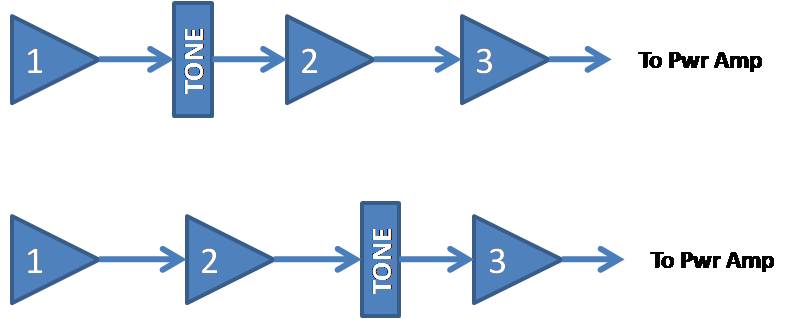
We're going to work through the amplifier from the guitar input to speaker output. So, let's start in the preamps and get a feel for how they're put together. We're, truly, not yet into the "voicing" part of it, we're just looking at how things are laid out and put together in a structured block format. I'm going to try to attach files, here, so if this works out there should be a JPG file attached with a bunch of triangles and a rectangle. The triangles represent a "gain stage" with all the frequency-based elements included in it. This would be a stage with an active component such as a tube, op-amp, transistor, FET, or other element that can provide signal gain. The "TONE" rectangle simply represents whatever tone control(s) is included with the amplifier.
There are two basic topologies (layouts) that are typically used in almost every ampilfier produced, today. Of course, there can be many variations on a given them, but the basics are there. If you look at the attached illustration, the top drawing is what I will typically refer to as the "Fender topology". In most, not all but most, Fender amps there is a single gain stage which is immediately followed by the tone stack/controls. This is then followed by one, or more, gain stages. This diagram shows three additional stages. Amps such as the Fender Deluxe (original) had a single tone control and two gain stages. In fact, most Fender amps don't have the third gain stage. The newer FAT Series amps (Hot Rod Deluxe, Blues Junior, Hot Rod Deville) all have 3 gain stages, as shown above.
In the Fender topology the tone stack is placed BEFORE the distortion is generated in the amplifier. It'd take a very strong guitar to distort the first stage of a Fender amplifier. A normal guitar has an RMS output of about 80-85mV (.085 volts) RMS. It takes approximately 2.5V RMS to overdrive a standard first stage of a guitar amp. The guitar signal would have to amplified to a level 30 times greater than what it is (doesn't even happen with active pickups) to get the first stage to distort.
So, that said, any distortion that gets generated occurs in stage 2 (on most Fenders) and/or stages 2 and 3 (on the FAT-series). The tone stack, then, helps to shape the distortion - meaning it provides the voicing for the distortion (balance of highs and lows).
The "Marshall" topology is shown on the bottom. If you'll notice, here, that there are 2, or more, gain stages prior to the tone stack/controls. A Peavey 5150, for example, has 5 stages prior to the tone controls. In this topology all of the distortion is generated BEFORE the signal reaches the tone control(s) in the amplifier. In these amplifiers the tone stack actively shapes the resulting distortion and allows you, the user, to control the "sound" of the distortion, but not the overall voicing of the preamplifier.
VOX/Matchless, Soldano, THD follow the Marshall topology, with the tone stacks after all the distortion is generated. Fender copies, of course, place the tone stacks at the very front of the amp.
So, the question comes into play, why not just put the tone stack as the very first thing and ALL the gain stages after? And that, is a very good question. The tone stack itself is a "signal suck"... meaning that what you get out of it, in terms of signal is a LOT less than what you put into the thing, especially if the controls are turned to their minimum position. Almost all of the signal, in that situation is "bled" to ground, or "shorted" to ground and very little of it is actually fed to the next stage. If you get near a Fender amp, sometime in the near future, set all the tone controls to 0 and you'll notice you end up with very little output. On some Fenders, depending on values used in the tone stack, you will get no output, at all. VOX amps have a 10K resistor that helps with this. Some Fenders ('65 Deluxe Reverb") had a fixed midrange control setting, with only the Bass/Treble adjustable to get around this issue. At mid-settings, you're bleeding off roughly 50% of the total signal...
The guitar signal is SO low in amplitude/level that the tone stack would simply reduce it to nothing and there would be nothing to amplify, so at least one gain stage is added in order to get enough level to drive the next stage.
The basic lesson, to take away here is, simply this: Fender topologies place the tone stack/control immediately after the first stage. This makes the tone control settings an active part in voicing the resulting distortion and character of the amplifier. Marshall-like topologies, voiced specifically for distortion, have the tone controls located at, or very near, the end of the string of preamp gain stages. That tone control shapes the resultant distortion and does not assist in the voicing of the preamp.
Next up - Why Different Tubes Sound Different...
Dar
There are two basic topologies (layouts) that are typically used in almost every ampilfier produced, today. Of course, there can be many variations on a given them, but the basics are there. If you look at the attached illustration, the top drawing is what I will typically refer to as the "Fender topology". In most, not all but most, Fender amps there is a single gain stage which is immediately followed by the tone stack/controls. This is then followed by one, or more, gain stages. This diagram shows three additional stages. Amps such as the Fender Deluxe (original) had a single tone control and two gain stages. In fact, most Fender amps don't have the third gain stage. The newer FAT Series amps (Hot Rod Deluxe, Blues Junior, Hot Rod Deville) all have 3 gain stages, as shown above.
In the Fender topology the tone stack is placed BEFORE the distortion is generated in the amplifier. It'd take a very strong guitar to distort the first stage of a Fender amplifier. A normal guitar has an RMS output of about 80-85mV (.085 volts) RMS. It takes approximately 2.5V RMS to overdrive a standard first stage of a guitar amp. The guitar signal would have to amplified to a level 30 times greater than what it is (doesn't even happen with active pickups) to get the first stage to distort.
So, that said, any distortion that gets generated occurs in stage 2 (on most Fenders) and/or stages 2 and 3 (on the FAT-series). The tone stack, then, helps to shape the distortion - meaning it provides the voicing for the distortion (balance of highs and lows).
The "Marshall" topology is shown on the bottom. If you'll notice, here, that there are 2, or more, gain stages prior to the tone stack/controls. A Peavey 5150, for example, has 5 stages prior to the tone controls. In this topology all of the distortion is generated BEFORE the signal reaches the tone control(s) in the amplifier. In these amplifiers the tone stack actively shapes the resulting distortion and allows you, the user, to control the "sound" of the distortion, but not the overall voicing of the preamplifier.
VOX/Matchless, Soldano, THD follow the Marshall topology, with the tone stacks after all the distortion is generated. Fender copies, of course, place the tone stacks at the very front of the amp.
So, the question comes into play, why not just put the tone stack as the very first thing and ALL the gain stages after? And that, is a very good question. The tone stack itself is a "signal suck"... meaning that what you get out of it, in terms of signal is a LOT less than what you put into the thing, especially if the controls are turned to their minimum position. Almost all of the signal, in that situation is "bled" to ground, or "shorted" to ground and very little of it is actually fed to the next stage. If you get near a Fender amp, sometime in the near future, set all the tone controls to 0 and you'll notice you end up with very little output. On some Fenders, depending on values used in the tone stack, you will get no output, at all. VOX amps have a 10K resistor that helps with this. Some Fenders ('65 Deluxe Reverb") had a fixed midrange control setting, with only the Bass/Treble adjustable to get around this issue. At mid-settings, you're bleeding off roughly 50% of the total signal...
The guitar signal is SO low in amplitude/level that the tone stack would simply reduce it to nothing and there would be nothing to amplify, so at least one gain stage is added in order to get enough level to drive the next stage.
The basic lesson, to take away here is, simply this: Fender topologies place the tone stack/control immediately after the first stage. This makes the tone control settings an active part in voicing the resulting distortion and character of the amplifier. Marshall-like topologies, voiced specifically for distortion, have the tone controls located at, or very near, the end of the string of preamp gain stages. That tone control shapes the resultant distortion and does not assist in the voicing of the preamp.
Next up - Why Different Tubes Sound Different...
Dar