#1 · Aug 14, 2008 17:19 UTC
The topic if this section - the Fender Tone Stack Implementations...
There are three basic "tone stack" implementations in Fender's most popular amp lines. Granted, there are a few other implementations (especially in the less well-known Bassman's) that Fender used, but there are three basic ones:
1) Single tone control - a.k.a. "high cut"
2) Dual tone control (Bass / Treble)
3) Triple Tone Control (Bass / Mid / Treble)
I will explain each tone control section in a separate post, within this topic.
So, the first one - "high cut". This is a common implementation of a tone stack found in many amps, not just the Fenders. It amounts to a "high cut" network systematically removing more, and more, high frequencies from the resulting signal (your guitar).
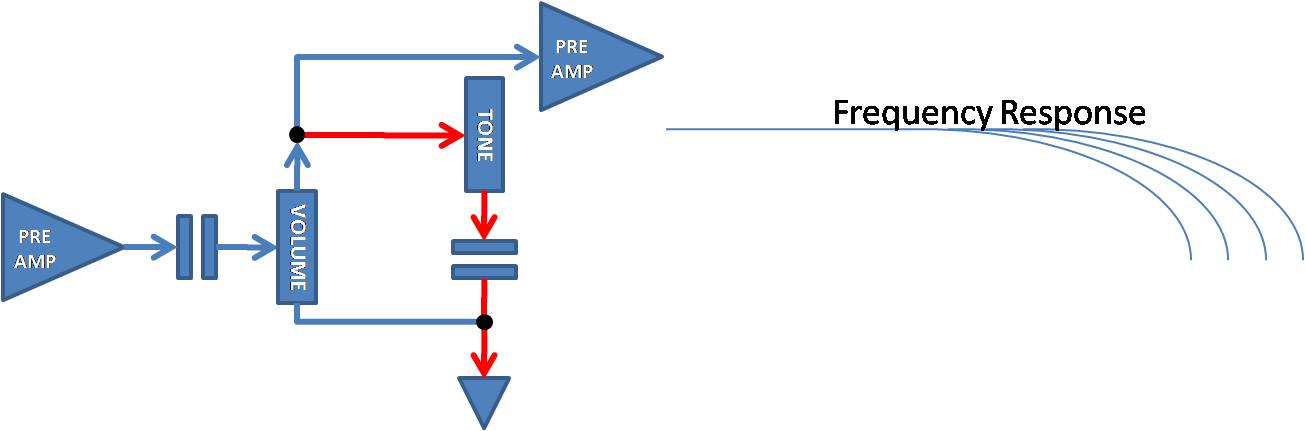
There are some things to note, here, that you may not have thought about, in times past. If you look at the "Frequency Response" chart, to the right of this little gem, you'll notice that the output is relatively flat from the low frequencies (left) to the midrange frequencies (right). Above the midrange the frequency response starts to "roll-off". This is what is known as a low pass filter, as it allows low frequencies through and high frequencies are "shunted".
Notice the tone control. This control is a variable resistor, or potentiometer (a.k.a. "pot" - though I hesitate to use that latter term ;) ). There are 3 "legs" on a pot. The top, the "wiper" (the one with the arrow) and the bottom terminal. The "wiper" will "travel" as you rotate the control from the top to the bottom terminal. When the wiper is moved all the way toward the top there is 0 resistance between the wiper and the top terminal and maximum resistance between the wiper and the bottom terminal. When the wiper is moved the other way the reverse occurs. If the wiper is in the center of the control there is, essentially equal resistance between the wiper and the top terminal and the wiper and the bottom terminal.
A couple of other things to point out, here. The dual, horizontal "bars" under the "TONE" control, and the vertical, parallel, bars between the "PREAMP" and "VOLUME" controls are what are known as capacitors. Capacitors have interesting charactaristics.
1) They only pass AC (signals). They block, and do not pass, DC signals.
2) As the frequency gets lower, and lower, the capacitor looks more and more like an open circuit (blocking low frequencies).
3) As the frequencies get higher and higher, the capacitor looks more and more like an open circuit (looks more like a "short" for high frequencies).
Some "tomes" would have you believe that all capacitors are "shorted" at high frequencies and that is not the case. All capacitors show some minimal amount of "resistance" (correct term would be reactance, or impedance) at high frequencies. They do not short out, although in some cases, it's almost proper to think of it that way. Technically, though, it's not correct. Just be aware.
You can think of a capacitor as a "frequency dependant resistor" having less resistance at high frequencies than what it does at low frequencies. That's the easiest way to put it, I think.
Back to the "hi-cut" circuit. As the tone control wiper is moved toward the bottom terminal of the control, there will be less and less resistance provided by the pot, to the signal, effectively "shorting" the signal from the wiper to the bottom terminal of the pot. This means, then, that most of the signal is now across the capacitor. It will "block" low frequencies and "short" high frequencies.
When the wiper is at/near the top terminal of the "TONE" control you will get a frequency response similar to that on the far right - almost all of the high frequencies will be allowed through the amp. When the wiper is at/near hte bottom terminal of the "TONE" control the frequency response will be similar to that of the far left curve, with much of the high frequency content being "shunted" or "removed" and only the lows and lower midrange being allowed through the amp.
One final note, here, and that's the overall response of this tone stack and the amp. As you recall from the previous "Fender" section, ALL preamp stages in the Fender amps are designed for flat frequency response. If you look at the resultant output of the tone stack you'll note that it's "flat" from the bass side all the way through to where the hi-cut control (TONE) removes some of the high frequencies.
You'll see, when we get to the next two tone controls, that most amps DO NOT exhibit this "flat" response through the midrange. This is, sometimes, also referred to as "smooth through the midrange", as well. You can obtain a similar response, with the standard tone controls (Bass / Middle / Treble) by setting the "Mid" to 10, the Bass and Treble to "0".
That should about cover the "hi-cut" version of the tone stack. Gibson, Marshall and others have all used this circuit, or variations thereof, to produce the hi-cut. The larger the capacitor the "lower" into the midrange the hi-cut will dip. The larger the tone control pot the more "control" you'll have over the cut - to a certain extent. A smaller value capacitor will "extend" the high frequency response even when the tone control is set for full cut.
Enjoy...
Dar
There are three basic "tone stack" implementations in Fender's most popular amp lines. Granted, there are a few other implementations (especially in the less well-known Bassman's) that Fender used, but there are three basic ones:
1) Single tone control - a.k.a. "high cut"
2) Dual tone control (Bass / Treble)
3) Triple Tone Control (Bass / Mid / Treble)
I will explain each tone control section in a separate post, within this topic.
So, the first one - "high cut". This is a common implementation of a tone stack found in many amps, not just the Fenders. It amounts to a "high cut" network systematically removing more, and more, high frequencies from the resulting signal (your guitar).
There are some things to note, here, that you may not have thought about, in times past. If you look at the "Frequency Response" chart, to the right of this little gem, you'll notice that the output is relatively flat from the low frequencies (left) to the midrange frequencies (right). Above the midrange the frequency response starts to "roll-off". This is what is known as a low pass filter, as it allows low frequencies through and high frequencies are "shunted".
Notice the tone control. This control is a variable resistor, or potentiometer (a.k.a. "pot" - though I hesitate to use that latter term ;) ). There are 3 "legs" on a pot. The top, the "wiper" (the one with the arrow) and the bottom terminal. The "wiper" will "travel" as you rotate the control from the top to the bottom terminal. When the wiper is moved all the way toward the top there is 0 resistance between the wiper and the top terminal and maximum resistance between the wiper and the bottom terminal. When the wiper is moved the other way the reverse occurs. If the wiper is in the center of the control there is, essentially equal resistance between the wiper and the top terminal and the wiper and the bottom terminal.
A couple of other things to point out, here. The dual, horizontal "bars" under the "TONE" control, and the vertical, parallel, bars between the "PREAMP" and "VOLUME" controls are what are known as capacitors. Capacitors have interesting charactaristics.
1) They only pass AC (signals). They block, and do not pass, DC signals.
2) As the frequency gets lower, and lower, the capacitor looks more and more like an open circuit (blocking low frequencies).
3) As the frequencies get higher and higher, the capacitor looks more and more like an open circuit (looks more like a "short" for high frequencies).
Some "tomes" would have you believe that all capacitors are "shorted" at high frequencies and that is not the case. All capacitors show some minimal amount of "resistance" (correct term would be reactance, or impedance) at high frequencies. They do not short out, although in some cases, it's almost proper to think of it that way. Technically, though, it's not correct. Just be aware.
You can think of a capacitor as a "frequency dependant resistor" having less resistance at high frequencies than what it does at low frequencies. That's the easiest way to put it, I think.
Back to the "hi-cut" circuit. As the tone control wiper is moved toward the bottom terminal of the control, there will be less and less resistance provided by the pot, to the signal, effectively "shorting" the signal from the wiper to the bottom terminal of the pot. This means, then, that most of the signal is now across the capacitor. It will "block" low frequencies and "short" high frequencies.
When the wiper is at/near the top terminal of the "TONE" control you will get a frequency response similar to that on the far right - almost all of the high frequencies will be allowed through the amp. When the wiper is at/near hte bottom terminal of the "TONE" control the frequency response will be similar to that of the far left curve, with much of the high frequency content being "shunted" or "removed" and only the lows and lower midrange being allowed through the amp.
One final note, here, and that's the overall response of this tone stack and the amp. As you recall from the previous "Fender" section, ALL preamp stages in the Fender amps are designed for flat frequency response. If you look at the resultant output of the tone stack you'll note that it's "flat" from the bass side all the way through to where the hi-cut control (TONE) removes some of the high frequencies.
You'll see, when we get to the next two tone controls, that most amps DO NOT exhibit this "flat" response through the midrange. This is, sometimes, also referred to as "smooth through the midrange", as well. You can obtain a similar response, with the standard tone controls (Bass / Middle / Treble) by setting the "Mid" to 10, the Bass and Treble to "0".
That should about cover the "hi-cut" version of the tone stack. Gibson, Marshall and others have all used this circuit, or variations thereof, to produce the hi-cut. The larger the capacitor the "lower" into the midrange the hi-cut will dip. The larger the tone control pot the more "control" you'll have over the cut - to a certain extent. A smaller value capacitor will "extend" the high frequency response even when the tone control is set for full cut.
Enjoy...
Dar