#1 · Aug 14, 2008 20:50 UTC
All kinds of interesting things occur in the power section of Fender and/or other amplifiers. There are two basic topologies used in the power sections of Fender amps - SE (Single Ended) or P-P (Push Pull). The lower powered amplifiers (Champs, Bronco's, etc) are all SE style amplifiers and the higher powered amps (Twins, Deluxes, Bassmans, etc) are all P-P style amplifiers.
There are a LOT of myths, legends and creative ideas about what goes on in a power amplifier section, the "sound of tubes" and whatnot that are, in many cases, VERY untrue. I'm going to try to talk through some of those, here, but may address some in a more generic topic on power amp sections in tube amps - another topic. Many of the myths have much less to do with the actual tubes used and MUCH MORE to do with the components (i.e. transformer quality, biasing, screen resistors, speakers, etc.).
Let's take a look, first, at the "easier" of the two topologies, the single-ended. All single ended amps run in Class A. Ooooohhhh... that venerable "Class A" sound, where the tube runs all the time and, supposedly, sounds better. Let's start out by talking through some basic elements of most SE circuits. In one of the first installments of this series of posts, I discussed, briefly, the purpose of the cathode resistor in a tube gain stage - remember that resistor on the bottom of the tube???? :o
This resistor does a bunch of things for the tube. 1) It sets the DC bias, or operating point for the tube. The larger this value the more "linear" the tube is, especially for large input signal swings. The smaller this value the more "non-linear" the tube is and the less dynamic range the input signal can have. 2) It creates what is called "negative feedback..." This is similar to what your boss gives you, in the job. Constant feedback that's equal, or nearly so, and opposite of what you'd like suppressing your creativity and output! In truth, that's EXACTLY what negative feedback does - it controls the output AND reduces overall gain of the stage(s) it's fed into. Negative feedback is always 180 degrees out of phase with the input.
All of that said, then, it can be seen that a well-designed single-ended amp does not need a feedback loop to control the gain. You simply put in a well thought out and properly sized cathode resistor in the output tube circuit and the tube will self-regulate to the proper gain value and output level - automatically. As the tube ages this resistor will keep the tube operating in the correct region, again automatically, until it finally fizzles out and dies.
This lack of a feedback loop, in these SE amps, produced a unique character and sound that some of us really like. First, they're "dynamic" and "spongy" and "responsive". Great for blues players, especially. You can crank them up and they transition from undistorted power amp stage to mildly distorted to distorted - just like the preamp tubes do. They start out with soft clipping/limiting and move smoothly into distorted territory.
Another thing about amps without a feedback loop is the fact that they have a very low "damping factor". The "damping factor" is, to put it simply, the power amps ability to "control" the movement of the speaker. A technical definition goes something like this: The damping factor is the amplifiers ability to deal with back EMF generated by the speaker... the higher the damping factor the lower the output impedance, the lower the damping factor the higher the output impedance... when there is no feedback loop the power amp has a hard time controlling speaker movement especially at the low resonant frequency of the speaker/cabinet combination and the high resonant frequency of the speaker cone/voice coil combination. This creates, in essence, a "mid-scoop" and a very non-linear (not flat) frequency response. To most people this sounds more "natural" because, interestingly enough, it's the reverse of the Fletcher-Munson curve, de-emphasizing those frequencies to which our ears are the most sensitive and emphasizing those to which we're least sensitive.
Because the tube has to be biased so "hot" to run in Class A, the amount of total output power delivered to the speaker is VERY low (5-15 watts). Low output power = nice bedroom/studio levels. They made great practice amps, and what not. Low component counts, low wattage transformers = lower cost, as well. In the Fender line the "Champ" was the most popular SE amplifier. The Champ ended up coming in a LOT of flavors and styles over the years, some with tone controls (single and double), some without - all of them sported a single 6V6 output tube driving a transformer.
Remember I stated, in a previous post, that Fender was all about "clean" from input to output? Well, Fender added, on many of their SE amps, a feedback loop. This was "tapped" off the output transformer and typically fed back into the preamp tube that fed the power tube. Why???
Negative feedback, especially in a loop like this, increases the damping factor, decreases harmonic distortion and noise and improves power amp linearity (flattens frequency response). By decreasing distortion, Fender was able to run those amps clean almost to the limits of the volume control. The "bad" thing about a lot of negative feedback is that the power amp no longer smoothly transitions from "clean" to "slightly overdriven" to "distorted" it goes from clean to horridly distorted immediately with no middle ground and that latter distortion is not the nice "tubey" sound we like to hear, it's rather more like "digital distortion" or like "solid-state", highly "buzzy" distortion.
Fender, in most of the power amp sections, used the Cathode resistor to bias the tube for DC operation (current) and bypassed it with a sufficiently large capacitor. This capacitor increases signal gain to as high as it can go (limited by the circuit). The output was fed to the output transformer and feedback, in many instances, was tapped off the output transformer to feed into the preamp to linearize the amp.
The more negative feedback fed back into the preamp/splitter section the more linear the output stage will get, the harsher the transistion from clean to distortion will become. This also lowers the gain of the amplifer considerably by doing this. Overall, though, the cleaner the output stage gets. This high amount of negative feedback creates a much "tighter" output sound and it's more "focused". Many Fender amps, especially the early ones, didn't have a lot of negative feedback in the SE amps, but they had some - just enough to "clean up" some issues. Those small cabinets tended to resonate at very "nasally" frequencies. The negative feedback, I believe, helped to control those resonances and make the amps sound a bit better, overall.
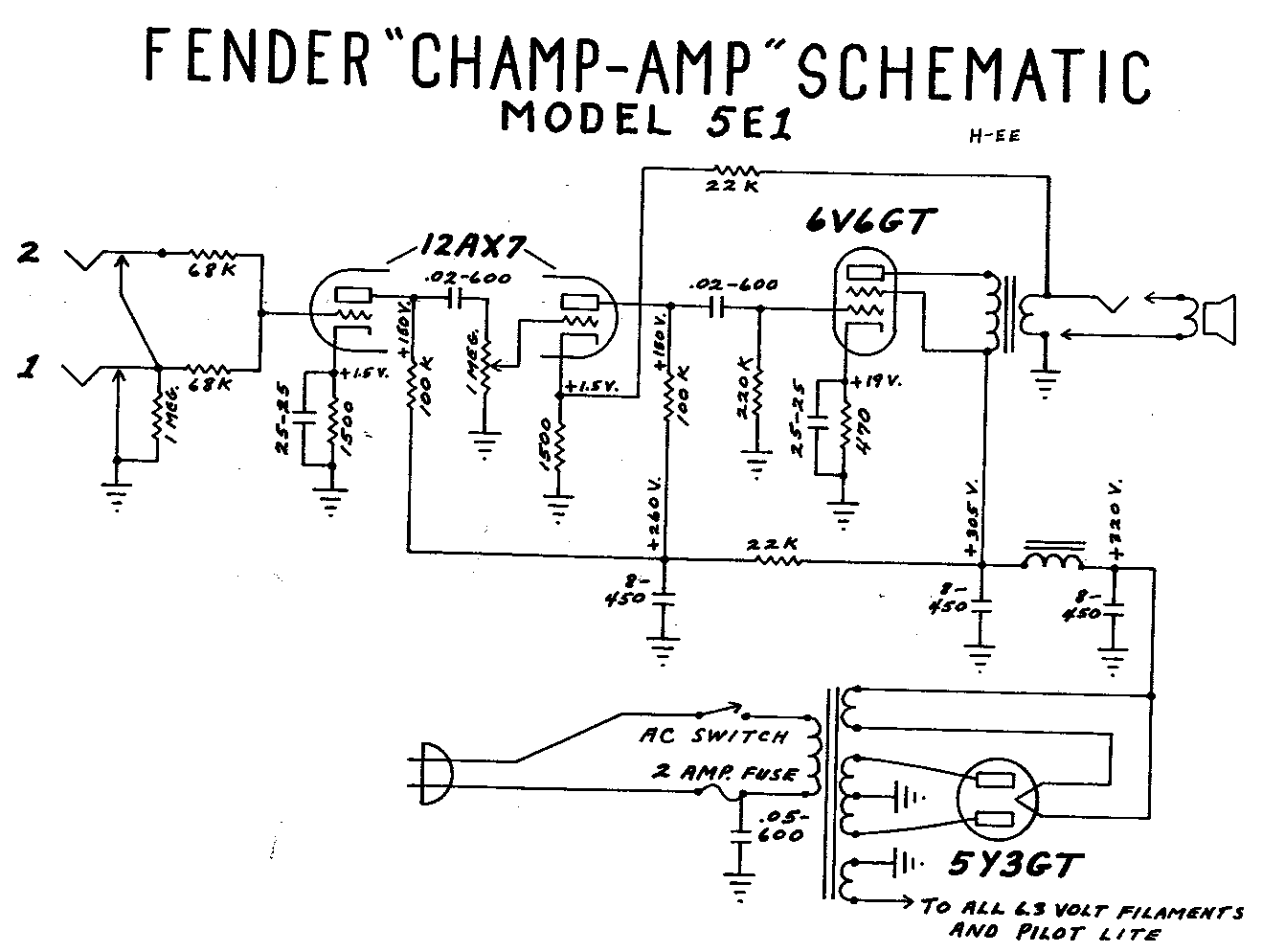
Light amounts of negative feedback will transistion the amp back to a more "spongy" feel, reduce the damping factor and have more of the resonances take precedence. You can vary the amount of negative feedback, in the amp, by changing the feedback resistors. We can talk about that further if anyone would like. I have included a sample schematic, here, of an SE output Fender. Note the line running from the speaker side of the OT back into the preamp. That is afeedback loop.
Dar
There are a LOT of myths, legends and creative ideas about what goes on in a power amplifier section, the "sound of tubes" and whatnot that are, in many cases, VERY untrue. I'm going to try to talk through some of those, here, but may address some in a more generic topic on power amp sections in tube amps - another topic. Many of the myths have much less to do with the actual tubes used and MUCH MORE to do with the components (i.e. transformer quality, biasing, screen resistors, speakers, etc.).
Let's take a look, first, at the "easier" of the two topologies, the single-ended. All single ended amps run in Class A. Ooooohhhh... that venerable "Class A" sound, where the tube runs all the time and, supposedly, sounds better. Let's start out by talking through some basic elements of most SE circuits. In one of the first installments of this series of posts, I discussed, briefly, the purpose of the cathode resistor in a tube gain stage - remember that resistor on the bottom of the tube???? :o
This resistor does a bunch of things for the tube. 1) It sets the DC bias, or operating point for the tube. The larger this value the more "linear" the tube is, especially for large input signal swings. The smaller this value the more "non-linear" the tube is and the less dynamic range the input signal can have. 2) It creates what is called "negative feedback..." This is similar to what your boss gives you, in the job. Constant feedback that's equal, or nearly so, and opposite of what you'd like suppressing your creativity and output! In truth, that's EXACTLY what negative feedback does - it controls the output AND reduces overall gain of the stage(s) it's fed into. Negative feedback is always 180 degrees out of phase with the input.
All of that said, then, it can be seen that a well-designed single-ended amp does not need a feedback loop to control the gain. You simply put in a well thought out and properly sized cathode resistor in the output tube circuit and the tube will self-regulate to the proper gain value and output level - automatically. As the tube ages this resistor will keep the tube operating in the correct region, again automatically, until it finally fizzles out and dies.
This lack of a feedback loop, in these SE amps, produced a unique character and sound that some of us really like. First, they're "dynamic" and "spongy" and "responsive". Great for blues players, especially. You can crank them up and they transition from undistorted power amp stage to mildly distorted to distorted - just like the preamp tubes do. They start out with soft clipping/limiting and move smoothly into distorted territory.
Another thing about amps without a feedback loop is the fact that they have a very low "damping factor". The "damping factor" is, to put it simply, the power amps ability to "control" the movement of the speaker. A technical definition goes something like this: The damping factor is the amplifiers ability to deal with back EMF generated by the speaker... the higher the damping factor the lower the output impedance, the lower the damping factor the higher the output impedance... when there is no feedback loop the power amp has a hard time controlling speaker movement especially at the low resonant frequency of the speaker/cabinet combination and the high resonant frequency of the speaker cone/voice coil combination. This creates, in essence, a "mid-scoop" and a very non-linear (not flat) frequency response. To most people this sounds more "natural" because, interestingly enough, it's the reverse of the Fletcher-Munson curve, de-emphasizing those frequencies to which our ears are the most sensitive and emphasizing those to which we're least sensitive.
Because the tube has to be biased so "hot" to run in Class A, the amount of total output power delivered to the speaker is VERY low (5-15 watts). Low output power = nice bedroom/studio levels. They made great practice amps, and what not. Low component counts, low wattage transformers = lower cost, as well. In the Fender line the "Champ" was the most popular SE amplifier. The Champ ended up coming in a LOT of flavors and styles over the years, some with tone controls (single and double), some without - all of them sported a single 6V6 output tube driving a transformer.
Remember I stated, in a previous post, that Fender was all about "clean" from input to output? Well, Fender added, on many of their SE amps, a feedback loop. This was "tapped" off the output transformer and typically fed back into the preamp tube that fed the power tube. Why???
Negative feedback, especially in a loop like this, increases the damping factor, decreases harmonic distortion and noise and improves power amp linearity (flattens frequency response). By decreasing distortion, Fender was able to run those amps clean almost to the limits of the volume control. The "bad" thing about a lot of negative feedback is that the power amp no longer smoothly transitions from "clean" to "slightly overdriven" to "distorted" it goes from clean to horridly distorted immediately with no middle ground and that latter distortion is not the nice "tubey" sound we like to hear, it's rather more like "digital distortion" or like "solid-state", highly "buzzy" distortion.
Fender, in most of the power amp sections, used the Cathode resistor to bias the tube for DC operation (current) and bypassed it with a sufficiently large capacitor. This capacitor increases signal gain to as high as it can go (limited by the circuit). The output was fed to the output transformer and feedback, in many instances, was tapped off the output transformer to feed into the preamp to linearize the amp.
The more negative feedback fed back into the preamp/splitter section the more linear the output stage will get, the harsher the transistion from clean to distortion will become. This also lowers the gain of the amplifer considerably by doing this. Overall, though, the cleaner the output stage gets. This high amount of negative feedback creates a much "tighter" output sound and it's more "focused". Many Fender amps, especially the early ones, didn't have a lot of negative feedback in the SE amps, but they had some - just enough to "clean up" some issues. Those small cabinets tended to resonate at very "nasally" frequencies. The negative feedback, I believe, helped to control those resonances and make the amps sound a bit better, overall.
Light amounts of negative feedback will transistion the amp back to a more "spongy" feel, reduce the damping factor and have more of the resonances take precedence. You can vary the amount of negative feedback, in the amp, by changing the feedback resistors. We can talk about that further if anyone would like. I have included a sample schematic, here, of an SE output Fender. Note the line running from the speaker side of the OT back into the preamp. That is afeedback loop.
Dar