#1 · Aug 14, 2008 22:37 UTC
The final topic, in this section, is "interstage coupling". Yeah, sounds a bit "off topic" but it's a real term and something critical to the overall operation, performance and voicing of any tube amplifier. Here's something you may not have thought about... a tube stage can only take a signal swing of roughly 3V peak to peak, or 1.5V positive and 1.5V negative before things get out of hand.
Your guitar signal is roughly 80mV. The gain of the first stage, on many tube amps is, roughly 40. Doing the math, .080V x 40 = 3.2V. Now, this value is RMS and real "peak" values are higher. 3.2V / .707 = Peak to peak voltage. That yeilds a number around 4.5V, or 1.5 MORE than what the next stage can handle without distorting significantly.
Enter "interstage coupling". In its basic form, interstage coupling consists of two elements a capacitor hooked directly to the plate of the preceding stage and a resistor connected to the other side of that cap. The opposite side of the resistor is at ground. The usual resistor size is 1M (1 mega-ohm, or 1,000,000 ohms). There is a reason for this RC combination. First, the preceding tube plate (where the signal is "tapped" from) is running at 150V DC. If I just used resistors in this "attenuator" network, some, if not all, of that 150V would be fed directly to the grid of the next stage. That would way overbias the tube causing it to turn into a small fourth of July event. Not a good thing to have happen inside your nice, new, and shiny tube amp.
So, enter the capacitor. Capacitors block DC. NICE! Now, the DC is gone from the picture. They also, as discussed earlier provide resistance (reactance) to AC signals so the capacitor will "resist" or "drop" some of the output signal voltage from the first stage, reducing its level into the next stage following. Again, nice. When two "resistors" are stacked on top of one another, with the bottom one connected to ground, we have what is called a "voltage divider". The voltage feeding into the top one is "divided" or "split" between the top "resistor" and the bottom one. The signal is taken, or tapped, off the bottom resistor and it's smaller than the total signal. Also nice!
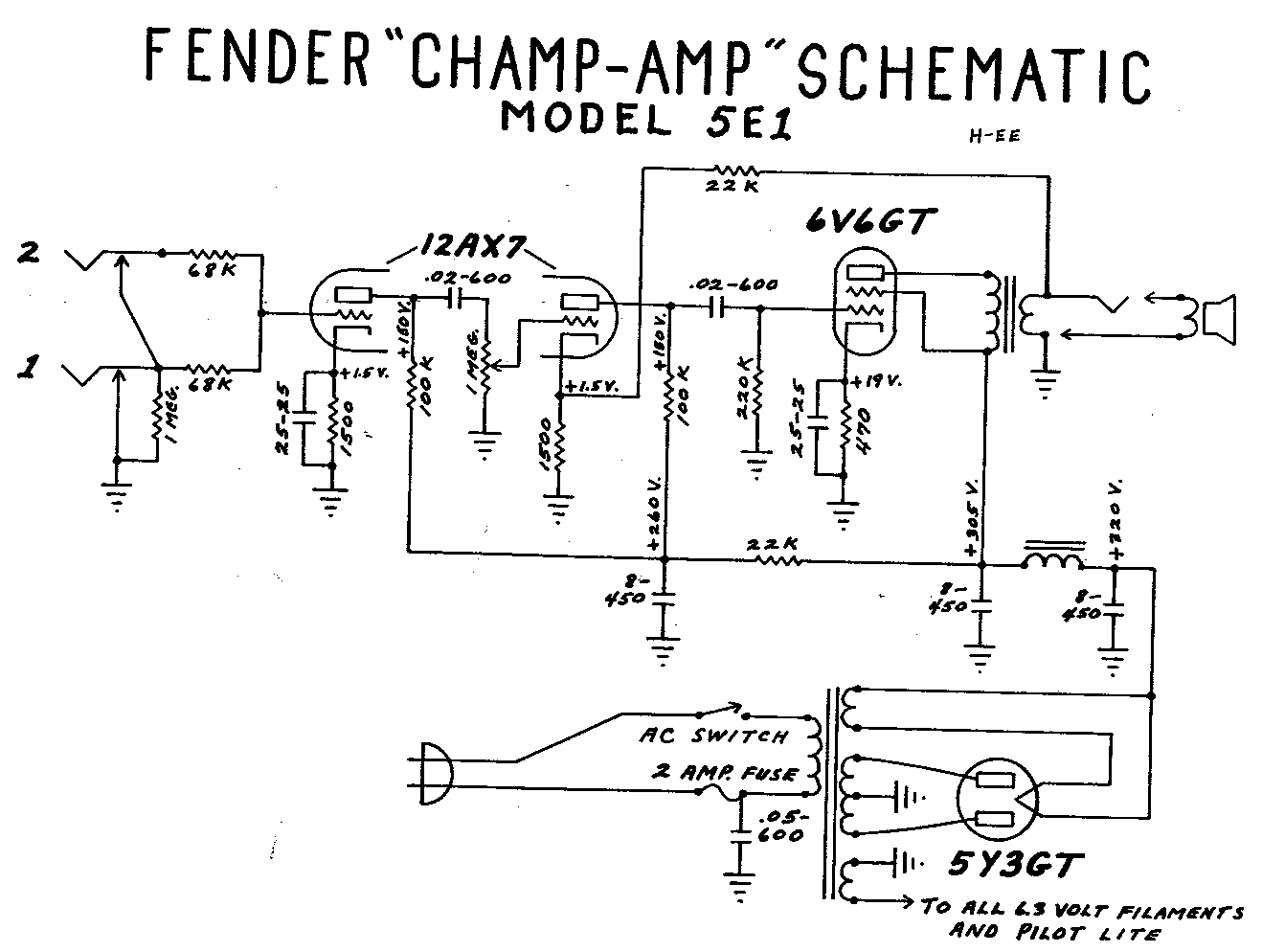
I have reattached the "Champ 5E1" schematic to this thread. You can see an example of interstage coupling, between stage 1, and stage 2 of this amp. The capacitor marked ".02 - 600" and the potentiometer marked "1MEG" form the "interstage coupling" for this amplifier. The .02uF capacitor "blocks" DC from the plate of first gain stage. The 1M forms the bottom portion of the voltage divider.
In any amp, this forms what would be known as a "high pass filter". However, the value of the capacitor is chosen, in Fender Amps especially, to be large enough to allow all frequencies from 20Hz to 20kHz through. This combination (.02uF and 1MEG) yeilds a frequency response of 8Hz to the limit of the high frequencies reproduced by a 12AX7 - (typically about 23kHz). You will see a similar combination feeding the power stage of the Champ. This time, it's a .02uF capacitor feeding a 220K resistor. The response of this circuit turns out to be about 35Hz and up - still WAY LOWER than the single 8" speaker, in that amp, could reproduce. Even a 12" speaker, which starts to roll off significantly below about 100Hz would have a hard time reproducing that.
In many Fender amplifiers with a full tone stack between Stage 1 and Stage 2 (full meaning 2 or 3 controls) you will not see a capacitor coupled, or hooked, directly to the plate of the preceding tube. That's due to the fact that the three capacitors, in the tone stack, block DC from flowing through the tone stack into the next stage. There is no DC path through the stack. Thus no additional capacitor is necessary.
FENDER TOPOLOGY SUMMARY
Fender amps, as has been discussed, were designed to operate without distortion. As such, the tube stages, in the preamp, were designed to run completely "flat" with no frequency, or tonal, shaping at all. The links between the preamp stages, and the preamp and power amp, were also designed in exactly the same way, to provide full frequency response with no tonal shaping.
In almost all Fender amps, the ONLY tonal shaping that occurs is a result of the tone stack which is typically located between stage 1 and stage 2 of the preamplifier. The major exception to this "rule of Fender" is the 5F6 and 5F6-A Bassman which formed the basis from which Marshall amps were constructed.
When no tone control, or a single tone control was used, the amp had a bass and midrange was was "flat" and "smooth" in its tonal response. This yeilded a more "bluesy" sounding amp similar to the tone one obtains when turning the treble down, the bass down and the midrange up on a standard amplifier. Because of the demand for amps that "cut through" the band Fender introduced a tone stack that had 2 or 3 controls. This stack had a "slope" resistor which determined the balance of low and high frequencies and also provided a "notch" which separated the lows from the highs typically centered around cabinet resonances that sounded "boxy" in the 3-400Hz range. Fender amps have a high value slope resistor (100K typical) which yeilds a much more "trebly" output. This, coupled with a small value treble capacitor (270pF typical) gives the Fenders that "glassy" high-end that they're known, and respected, for.
There are two power amp types: SE (Class A) and P-P (Class AB1). Both yeild the same end result - making the signal stronger, but the Class AB1 provides a much more efficient way to generate output power than Class A. Class A amps, single-ended, have a cathode bias resistor and corresponding cathode bypass capacitor which provides the "negative feedback" necessary for the power amp. However, Fender also added a feedback loop, on many of their SE amps, to help them run cleaner, more distortion free.
Leaving out negative feedback (removing the loop) decreases the damping factor allowing the speaker and cabinet resonances to be more fully realized and producing an inverse of the Fletcher-Munson curve. This yields an amp that most typically call "dynamic" or "responsive" and others call "loose" and "flubby". Adding negative feedback increases the amplifier damping factor, controlling both speaker and cabinet resonances and "tightening" response. This makes some folks happy and it makes others think of the amp as "sterile" or "lifeless". Both have their inherent strengths and weaknesses.
With that, I believe we shall end our review of Fender topologies. We can get into more depth if anyone would like me to, exploring more of a single design, or section of a particular amp. Tomorrow, I will try to put together something on the Marshall topology which differs, in many ways, from Fenders and some VERY surprisingly different ways...
ENJOY...
Dar
Your guitar signal is roughly 80mV. The gain of the first stage, on many tube amps is, roughly 40. Doing the math, .080V x 40 = 3.2V. Now, this value is RMS and real "peak" values are higher. 3.2V / .707 = Peak to peak voltage. That yeilds a number around 4.5V, or 1.5 MORE than what the next stage can handle without distorting significantly.
Enter "interstage coupling". In its basic form, interstage coupling consists of two elements a capacitor hooked directly to the plate of the preceding stage and a resistor connected to the other side of that cap. The opposite side of the resistor is at ground. The usual resistor size is 1M (1 mega-ohm, or 1,000,000 ohms). There is a reason for this RC combination. First, the preceding tube plate (where the signal is "tapped" from) is running at 150V DC. If I just used resistors in this "attenuator" network, some, if not all, of that 150V would be fed directly to the grid of the next stage. That would way overbias the tube causing it to turn into a small fourth of July event. Not a good thing to have happen inside your nice, new, and shiny tube amp.
So, enter the capacitor. Capacitors block DC. NICE! Now, the DC is gone from the picture. They also, as discussed earlier provide resistance (reactance) to AC signals so the capacitor will "resist" or "drop" some of the output signal voltage from the first stage, reducing its level into the next stage following. Again, nice. When two "resistors" are stacked on top of one another, with the bottom one connected to ground, we have what is called a "voltage divider". The voltage feeding into the top one is "divided" or "split" between the top "resistor" and the bottom one. The signal is taken, or tapped, off the bottom resistor and it's smaller than the total signal. Also nice!
I have reattached the "Champ 5E1" schematic to this thread. You can see an example of interstage coupling, between stage 1, and stage 2 of this amp. The capacitor marked ".02 - 600" and the potentiometer marked "1MEG" form the "interstage coupling" for this amplifier. The .02uF capacitor "blocks" DC from the plate of first gain stage. The 1M forms the bottom portion of the voltage divider.
In any amp, this forms what would be known as a "high pass filter". However, the value of the capacitor is chosen, in Fender Amps especially, to be large enough to allow all frequencies from 20Hz to 20kHz through. This combination (.02uF and 1MEG) yeilds a frequency response of 8Hz to the limit of the high frequencies reproduced by a 12AX7 - (typically about 23kHz). You will see a similar combination feeding the power stage of the Champ. This time, it's a .02uF capacitor feeding a 220K resistor. The response of this circuit turns out to be about 35Hz and up - still WAY LOWER than the single 8" speaker, in that amp, could reproduce. Even a 12" speaker, which starts to roll off significantly below about 100Hz would have a hard time reproducing that.
In many Fender amplifiers with a full tone stack between Stage 1 and Stage 2 (full meaning 2 or 3 controls) you will not see a capacitor coupled, or hooked, directly to the plate of the preceding tube. That's due to the fact that the three capacitors, in the tone stack, block DC from flowing through the tone stack into the next stage. There is no DC path through the stack. Thus no additional capacitor is necessary.
FENDER TOPOLOGY SUMMARY
Fender amps, as has been discussed, were designed to operate without distortion. As such, the tube stages, in the preamp, were designed to run completely "flat" with no frequency, or tonal, shaping at all. The links between the preamp stages, and the preamp and power amp, were also designed in exactly the same way, to provide full frequency response with no tonal shaping.
In almost all Fender amps, the ONLY tonal shaping that occurs is a result of the tone stack which is typically located between stage 1 and stage 2 of the preamplifier. The major exception to this "rule of Fender" is the 5F6 and 5F6-A Bassman which formed the basis from which Marshall amps were constructed.
When no tone control, or a single tone control was used, the amp had a bass and midrange was was "flat" and "smooth" in its tonal response. This yeilded a more "bluesy" sounding amp similar to the tone one obtains when turning the treble down, the bass down and the midrange up on a standard amplifier. Because of the demand for amps that "cut through" the band Fender introduced a tone stack that had 2 or 3 controls. This stack had a "slope" resistor which determined the balance of low and high frequencies and also provided a "notch" which separated the lows from the highs typically centered around cabinet resonances that sounded "boxy" in the 3-400Hz range. Fender amps have a high value slope resistor (100K typical) which yeilds a much more "trebly" output. This, coupled with a small value treble capacitor (270pF typical) gives the Fenders that "glassy" high-end that they're known, and respected, for.
There are two power amp types: SE (Class A) and P-P (Class AB1). Both yeild the same end result - making the signal stronger, but the Class AB1 provides a much more efficient way to generate output power than Class A. Class A amps, single-ended, have a cathode bias resistor and corresponding cathode bypass capacitor which provides the "negative feedback" necessary for the power amp. However, Fender also added a feedback loop, on many of their SE amps, to help them run cleaner, more distortion free.
Leaving out negative feedback (removing the loop) decreases the damping factor allowing the speaker and cabinet resonances to be more fully realized and producing an inverse of the Fletcher-Munson curve. This yields an amp that most typically call "dynamic" or "responsive" and others call "loose" and "flubby". Adding negative feedback increases the amplifier damping factor, controlling both speaker and cabinet resonances and "tightening" response. This makes some folks happy and it makes others think of the amp as "sterile" or "lifeless". Both have their inherent strengths and weaknesses.
With that, I believe we shall end our review of Fender topologies. We can get into more depth if anyone would like me to, exploring more of a single design, or section of a particular amp. Tomorrow, I will try to put together something on the Marshall topology which differs, in many ways, from Fenders and some VERY surprisingly different ways...
ENJOY...
Dar