#1 · Sep 06, 2008 00:51 UTC
OK... so I've talked about this, several times, in the past... I've made statements like: "If you remove half the power tubes you'll decouple the feedback loop and render it almost useless..." or "If you use the Groove Tubes Power Reducers, or the THD Yellow Jackets you'll decouple the feedback loop and render it useless..."
I've made those statements, but have provided, very little context into what those statements meant. So, in this post, I'll talk about that, a little bit. First, a "feedback loop" is all about "control" of the power amp. Feedback is provided, to control gain and power output, as well as significantly reduce harmonic distortion and improve linearity (frequency response) across the frequency range of the amplifier.
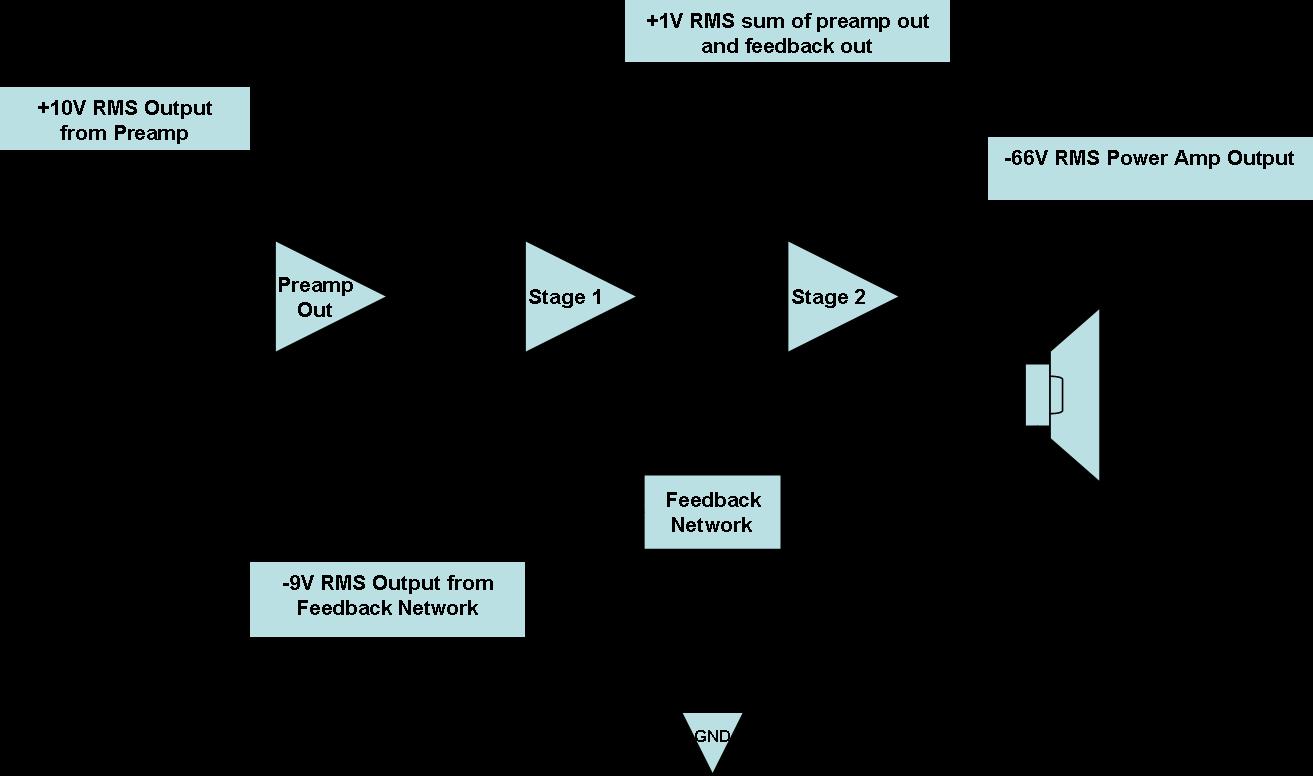
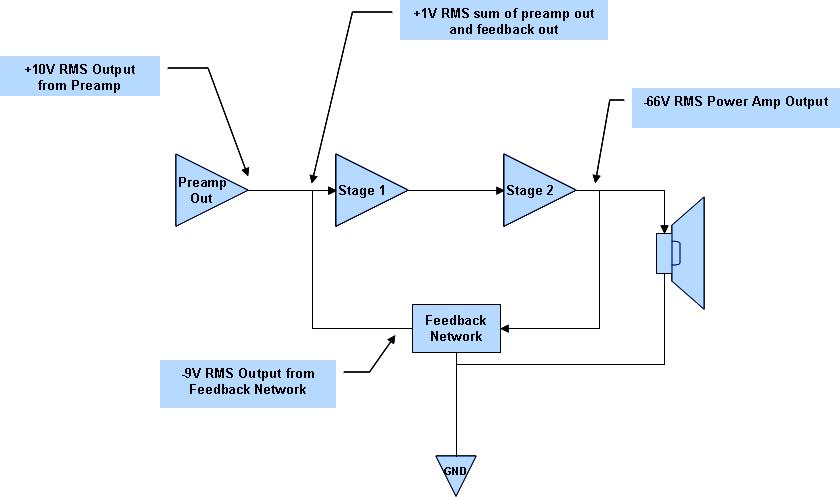
Negative feedback requires a constant ratio between the feedback voltage and the input voltage to the power amp, in order for it to work correctly. In the example, posted, I show a +10V RMS output from the preamp into the power amp. I show a -9V RMS output from the feedback network, feeding back into the power stage. When these two values are summed together, the result is a +1V RMS signal that actually feeds the preamp stage.
The -10V RMS, out of the feedback network is not a direct link from the speaker output. That feedback network has a voltage divider which actually reduces the output signal to a -10V RMS signal. Typically, it's just two resistors. The speaker output, in this particular example, is -66V RMS. This provides a stage gain of 66, where the input signal voltage is multiplied 66 times. 20 * log 66 = 36dB.
That's the "constrained" gain of the circuit. If I remove the feedback network, from this circuit, the "open loop gain" will be somewhat greater than 66. It has to be... you can't create gain with a negative feedback loop you can only take it away. So, let's say the open loop gain of the circuit is 100. The feedback network, then reduces the output from a gain of 100, to a gain of 60. 20 * log (100/60) = 4.4dB reduction in gain, via feedback. This is pretty "loose" in terms of damping. Feeding back a higher voltage to the input of the "stage 1" section of the power amp would increase the gain reduction to some higher value and "tighten" the response of the amp.
The above explanations are ALL DEPENDANT UPON the output voltage being -66V RMS! Let's say I remove two of the power tubes from the 4 in the output stage. I reduce the power output by 1/2, and reduce the output voltage, to the speakers by nearly 30%. This will create an output voltage out of the feedback network that's 30% lower, too. Rather than 9V out, now, I'll be getting 6.3V out. This INCREASES the amount of voltage entering the "Stage 1" section of the power amp and INCREASES the gain of the stage BY decoupling, to some extent, the amount of negative feedback.
Let's say I put in Power Reducers. I take my 100 watt amp to 7 watts! That's a 75% reduction in output voltage. Now, only 2.25V of negative feedback is present and the power stage is being fed with 7.75 volts from the preamp, not 1V. Thus, the power amp is certainly MUCH more prone to go non-linear as a result (i.e. distortion).
A second result of this is inherent non-linearity as a function of reducing the amount of negative feedback voltage that hits the power amp stage. The lower the output is dropped, as a result of reducing the number of power tubes, or putting in power reducers, the lower the amount of negative feedback and the "looser" the power stage is going to get. This will change the tone of the amp dramatically, to say the least.
What will end up happening??? If you have "Presence" and/or "Resonance" controls on the amp, they will be rendered ineffective after about a 50%, or so, drop in output voltage. Those controls are all implemented in the negative feedback loop and they just plain don't work.
Your amp will become more "voiced" by the speaker cabinet and the speaker and less by the preamp/power amp combination. It'll probably get "muddy", if you were used to listening to things a bit more "tightly controlled." It'll also get more "fizzy" as the speaker voice coil resonances take on a more active role in the output sound - especially if Fender-style speakers (high resonance peaks) were used.
These issues will occur under the following, typical conditions:
1) Removing power tubes from the power amp section to reduce power.
2) Installing "power reducers", including THD Yellow Jackets, Groove Tubes Power Reducers, etc.
3) Installing "Power Scaling" - something that's becoming very popular from London Power. Power scaling scales down the output voltage of the power amp and splitter stages (typically) by almost 95-99%, in some instances. O'Connor provides no control over the negative feedback and doesn't compensate for it, thus the tone of the amp should change quite a bit as the power is turned down.
Power attenuators, like the THD Hot Plate, Marshall Power Brake, Kendrick whatever, etc. will not do this. They "soak" power AFTER the output voltages have been derived and just waste that power as heat.
Anyway... I thought that you guys might find that interesting. In some cases, as in the case of my Hot Rod Deluxe, this had a positive effect on the overall tonality (at least to me) because I always thought the amp was too "tight" to begin with. In other cases, as in the case of my JSX, it turned the amp kind of "mushy" in terms of output. I ran power reducers in it, for a while, and kind of liked them, but recently switched back to my quartet of EL34's and like it MUCH better. The amp really "opens up", even though I don't play it loud, as a result of the feedback loop working appropriately.
That's about it. Enjoy your weekend... if I feel ambitious, I may take apart the Peavey C30, and show how Peavey voiced it, as well as discuss potential mods to it. I know a lot, on this forum, seem to have that amp, so that may be a useful topic...
Takers on that one?
Dar
I've made those statements, but have provided, very little context into what those statements meant. So, in this post, I'll talk about that, a little bit. First, a "feedback loop" is all about "control" of the power amp. Feedback is provided, to control gain and power output, as well as significantly reduce harmonic distortion and improve linearity (frequency response) across the frequency range of the amplifier.
Negative feedback requires a constant ratio between the feedback voltage and the input voltage to the power amp, in order for it to work correctly. In the example, posted, I show a +10V RMS output from the preamp into the power amp. I show a -9V RMS output from the feedback network, feeding back into the power stage. When these two values are summed together, the result is a +1V RMS signal that actually feeds the preamp stage.
The -10V RMS, out of the feedback network is not a direct link from the speaker output. That feedback network has a voltage divider which actually reduces the output signal to a -10V RMS signal. Typically, it's just two resistors. The speaker output, in this particular example, is -66V RMS. This provides a stage gain of 66, where the input signal voltage is multiplied 66 times. 20 * log 66 = 36dB.
That's the "constrained" gain of the circuit. If I remove the feedback network, from this circuit, the "open loop gain" will be somewhat greater than 66. It has to be... you can't create gain with a negative feedback loop you can only take it away. So, let's say the open loop gain of the circuit is 100. The feedback network, then reduces the output from a gain of 100, to a gain of 60. 20 * log (100/60) = 4.4dB reduction in gain, via feedback. This is pretty "loose" in terms of damping. Feeding back a higher voltage to the input of the "stage 1" section of the power amp would increase the gain reduction to some higher value and "tighten" the response of the amp.
The above explanations are ALL DEPENDANT UPON the output voltage being -66V RMS! Let's say I remove two of the power tubes from the 4 in the output stage. I reduce the power output by 1/2, and reduce the output voltage, to the speakers by nearly 30%. This will create an output voltage out of the feedback network that's 30% lower, too. Rather than 9V out, now, I'll be getting 6.3V out. This INCREASES the amount of voltage entering the "Stage 1" section of the power amp and INCREASES the gain of the stage BY decoupling, to some extent, the amount of negative feedback.
Let's say I put in Power Reducers. I take my 100 watt amp to 7 watts! That's a 75% reduction in output voltage. Now, only 2.25V of negative feedback is present and the power stage is being fed with 7.75 volts from the preamp, not 1V. Thus, the power amp is certainly MUCH more prone to go non-linear as a result (i.e. distortion).
A second result of this is inherent non-linearity as a function of reducing the amount of negative feedback voltage that hits the power amp stage. The lower the output is dropped, as a result of reducing the number of power tubes, or putting in power reducers, the lower the amount of negative feedback and the "looser" the power stage is going to get. This will change the tone of the amp dramatically, to say the least.
What will end up happening??? If you have "Presence" and/or "Resonance" controls on the amp, they will be rendered ineffective after about a 50%, or so, drop in output voltage. Those controls are all implemented in the negative feedback loop and they just plain don't work.
Your amp will become more "voiced" by the speaker cabinet and the speaker and less by the preamp/power amp combination. It'll probably get "muddy", if you were used to listening to things a bit more "tightly controlled." It'll also get more "fizzy" as the speaker voice coil resonances take on a more active role in the output sound - especially if Fender-style speakers (high resonance peaks) were used.
These issues will occur under the following, typical conditions:
1) Removing power tubes from the power amp section to reduce power.
2) Installing "power reducers", including THD Yellow Jackets, Groove Tubes Power Reducers, etc.
3) Installing "Power Scaling" - something that's becoming very popular from London Power. Power scaling scales down the output voltage of the power amp and splitter stages (typically) by almost 95-99%, in some instances. O'Connor provides no control over the negative feedback and doesn't compensate for it, thus the tone of the amp should change quite a bit as the power is turned down.
Power attenuators, like the THD Hot Plate, Marshall Power Brake, Kendrick whatever, etc. will not do this. They "soak" power AFTER the output voltages have been derived and just waste that power as heat.
Anyway... I thought that you guys might find that interesting. In some cases, as in the case of my Hot Rod Deluxe, this had a positive effect on the overall tonality (at least to me) because I always thought the amp was too "tight" to begin with. In other cases, as in the case of my JSX, it turned the amp kind of "mushy" in terms of output. I ran power reducers in it, for a while, and kind of liked them, but recently switched back to my quartet of EL34's and like it MUCH better. The amp really "opens up", even though I don't play it loud, as a result of the feedback loop working appropriately.
That's about it. Enjoy your weekend... if I feel ambitious, I may take apart the Peavey C30, and show how Peavey voiced it, as well as discuss potential mods to it. I know a lot, on this forum, seem to have that amp, so that may be a useful topic...
Takers on that one?
Dar