83 posts
There's a good thread on this topic over at TGP. Seems that almost everyone agrees, not that it's better or worse every time, but that it does make a difference and that it is a great tuning mechanism. Some people like it with almost all cabs and speakers. Some only occasionally use it. But all agree it makes a difference.
I have read a lot about this back in my prior life. In guitar cabs, even though we rarely are going for ultimate purity, some forms of distortion are better than others. The general things you could expect by putting insulation inside a guitar cab (primarily but not ONLY closed back) would be cleaner deeper bass, more tranparent mids, and just in general a more focused sound. The depth, size, shape and material used in the cab are all factors in how much change it makes. There is even one highly respected boutique amp maker who uses some in all his closed back cabs but also his open back combos!
Reason I'm bring this up now, is that I just got a new Lopo cab. It was an open back, that the guy I got it from bought new, and he made a panel that covers the opening, making it open/closed back convertible. He said he liked the cab but it didn't sound as good as his more expensive cab. The quick knuckle rap told me one reason. He used a VERY lively piece of wood to make the panel that closed the back. That cab is a front loader, so I figure it's a good candidate to experiment with. Also, since it is the smallest 1x12 I have, it will likely be the one I bury in the closet for recording, so I want it to be as dead as possible and to sound good.
I'm going to Wal Mart tonight to buy some Dupont Hollofil if I can find it. If not, some Dacron Polyfil. I'll let you know what I find out.
DreamTheaterRules — Feb 12, 2009 I have read a lot about this back in my prior life.
Wow. I didn't know fluffers in the porn industry had that much time to read! ::) :D
As for you little experiment, me thinks you should take pics before, during and after! (We all know it's too much to ask you - or me - for clips, right? ;) )
Get some owens-corning 703 and slap it in there. Not sure how useful it will be, but why the heck not? We've been building and throwing up traps all over the place at random, and they definitely work... not always in a way you want, but you never know unless you try.
pics of the before and after fluffing? The cab, that is. :D
Paul, have you ever done this? (I'm sensing a bit of ribbing... ;)) Don't worry, I'm not going to go nutso audiophile on you and say something like " if you take a 12" by 36" piece of 1" thick Hollofil and roll it up and sit it in the bottom of the cab, it will extend your bass 3dB down frequency by about 20hz and will make the bass more solid and defined." I'd never do anything like that. :)
I have read extensively on this in the past. In fact, back in the day, I read a mag called "Speaker Builder." I know the effects, but you don't so much hear it talked about in guitar circles. It could be a nice (and CHEAP) tuning mechanism. One guy at TGP said that in his cab, it made the difference much more clear, in the different speakers he'd try, and that it solidly influenced his final choice of speaker because his favorite sounded markedly better with some insulation in the cab.
There is some interesting info in that thread, including the fact that some classic Fender amps were completely stuffed full of insulation back in the 50s and 60s. And, I was not aware that many of the boutique guys were using it today. And lest you guys think I'm going nutty audiophile (and now comes the obligatory pic from Craig ;D) I might add that Bogner uses it. ;)
I'm basically talking the simplest form first: Just stapling a 1" thick sheet to the inside back of the cab. It should clean some mud out of the whole range, as it kills the backwave reflections that hit the cone and ARE clearly audible. Again, depending on speaker, cab and TASTE, this may or may not be preferable. It seems about 5-1 at TGP, that guys who tried it prefer it in some or all of their cabs.
I'm guessing it won't make too much of a difference unless you're actually playing something through it though... ;) ::)
Interestingly enough... you DO read about this in the guitar forums. :o You're just not reading the correct ones. The folks that have purchased the Fender G-DEC and the big brother to it, the 30-watter, pull the cabs apart and stuff them with hollow-fill, and/or mineral wool. The general consensus, for those amps, is that it dampens the higher frequency resonances those small cabinets produce, "smoothing" the output, overall, and making the cabinet much more musical. In addition to adding the insulation, a few folks are "tuning" those little ports in there, to help with low-end extension, as well.
This presents an interesting concept, really... it's something that some of the guitar cabinet designers are starting to play with. A standard, open-backed, cabinet has some funky resonances in the 600Hz to 800Hz region with an upward sloping response from 100Hz to that "peak" and then back down again immediately afterward (think triangle shape). Some have been "damping" those higher frequency resonances to "smooth" the overall tone of the cabinet and make it sound less "boxy".
Cabinet designs, NOW, with emphasis on NOW, focus on the creation, rather than the mitigation, of resonances within the cabinet. Back in the day, when the amps were originally built, the "shell" of the amp was built out of relatively rigid materials to stand the rigors of the road and transport. The more "protected" part of the amp (speaker baffle) wasn't made out of the "better" materials, 99.999% of the time out pure economy, more than anything.
That speaker baffle was "flimsy" and "floated" and "flexed" with the speaker movement - essentially performing part of the "resonator" function by itself. Later on in life, cabinet "designers" figured this out - probably about the time cabinets were starting to be constructed of pure MDF and started sounding really badly... The "better" designs, then, contained this "floating baffle" or "flexing" baffle.
After this period, then the "smart" amp designers began to write tomes on guitar amp cabinet design noting how early designers had "discovered" and "engineered" guitar cabinets specifically to sound musical, by using heavy plywoods and/or solid-wood sides on the speaker cabinets, and lighter woods for the baffles and backs of enclosures allowing the cabinet to "breathe" with the music when, in fact, NONE of the early designers even thought this way. What they were thinking is: 3/4", 13-ply birch costs an arm and a leg to buy and 3/8", 4-ply birch costs very little. Therefore, the less 3/4" product we use, the more money we save in the production process. THAT was the real "engineering" principal behind the cabinets.
Anyway... "damping" cabinet resonances, I think, would be a good idea. I also believe that constructively placing the damping materials would have the positive effect of better damping unwanted cabinet resonances (from poor construction/joinery techniques) and allowing more of the original "tonality" to come through.
Highly damped cabinets would effectively "isolate" the drivers, allowing the "voice" of the drivers to become the dominant factor, while lightly damped cabinets would be punctuated by cabinet resonances as much as they would be the driver. Moderately damped cabinets would be the "pleasant" balance between the resonances of the cabinet and the specific characteristics of the drivers.
I built a 2 x 8 cabinet out of pure, 3/4, dense MDF a while back. That cabinet weighs about 40lbs and doesn't resonate, at all. I put a small Celestion (8") in there and a Pioneer 8" woofer. Together, those speakers sound really awesome, but the tone is pure drivers, with non of the cabinet resonances. Putting those small speakers in a 3/8", birch baffle, rather than 3/4" MDF would make a world of difference in the "resonance" and "depth" coming from the cabinet, though...
Anyway... I ramble... those are some thoughts...
Dar
A standard, open-backed, cabinet has some funky resonances in the 600Hz to 800Hz region with an upward sloping response from 100Hz to that "peak" and then back down again immediately afterward (think triangle shape).
Dar, have you noticed the variety of back styles now on "open-back" cabs? It's obvious that some people are paying attention to where and how big the opening is. Example, the new avatar open back has an oval shaped opening in the center of the cab back. One boutique amp makers open back cabs have a "1/3 open back" and the opening is the middle, so it has top and bottom plates. Most are half or more open with a plate only at the bottom. One, makes his cab back in 1/3s with only the bottom one permanant, so you can have 1/3 open top, 1/3 open mid, or 2/3 open. He even goes as far as telling you what to expect with the different cab setups, AND suggests a favorite for different types of speakers.
Many others are now using some insulation in their cabs. Even the open back ones. Some have it only on the sides, top and bottom. Some on the sides and the back panel, etc. But when the topic came up, they all said they arrived at their preferred setup after lots of testing. So they are actually listening and deciding they like the cab better with some insulation. Obviously, in closed backs, it's even more prominent and noticeable. It was interesting when guys who had never experimented chimed in with comments like "I don't know what difference it makes, but I did notice that when I opened my Bogner cab, it had insulation inside it." This resulted in an amusing amount of "I've never opened mine up, I just know it sounds good" remarks from guys who didn't even know their cabs had insulation in them.
That in turn lead to several interesting conversations. The Bogner 1x12 "Cube" cab is well known for being a very good and very "large sounding" 1x12 cab. The Avatar 1x12 (of which I have two) is a replica of that cab, dimensions for sure, supposedly construction materials as well. I've heard often that people that compared the two with identical speakers said that while the Avatar sounds good, the Bogner sounds better. I always thought it was typical "I paid more so mine is better" type snobery. Turns out, it APPEARS to be nothing more than that the Bogner has some insulation in it. And that makes perfect sense. And makes me happy that I have two Avatars that I paid way less for, and now I can make them just as good. ;)
I just need to find the stuff! One guy said he got his at Wal-Mart. I went to Wally World after posting this the other night, and they didn't have any. Tried a different Wal-mart yesterday (there are 4 within 20 minutes of me) and they didn't either. Where can I get some nice Dacron Polyfil or better yet Dupont Hollofil? Time to google....
Please post where you found the right stuff once you do. Um, have you tried any building supply stores yet? You know, Homeless Depot, Blowes? ;)
Also, which is the preferred type AND can you put the stuff in temporarily (i.e., stuff it in through the open back hole and around the inside of the cab, then be able to remove it later if you wish)?
I still have three Avatar 1x12's and a 2x12 for guitar work so I'm interested to hear how your project comes out. :)
Craig, the basic premise is to staple sheets of it to back, sides or whatever. A level past that is to put a certain amount of it (by weight) into a certain cab volume. The first is just damping the cab reflections, the second is actually acoustically tuning the cab per more loudspeaker oriented guidelines. I'll probably stay more towards the first. In a home stereo speaker, I'd go directly to the second, to tune the low freq. rolloff etc.
This experiment will mainly stay in the realm of the first, since I have some DEEP cabs. If someone has a really shallow cab, I'd also go more towards the second as it increases the effect of having more cab volume (size). With deep cabs, I'd lean towards more just damping cab reflections which hit the cone, and thus influence tone.
Will the insulation stick to velcro by itself? Then you could just put the loop half inside the cab and stick the insulation in (plus you could then remove it somewhat easily as well).
Just a thought... I suppose you could also put the brush side on the velcro onto the insulation, but if it's not needed, even better!
most people staple it in, which is easily removable.
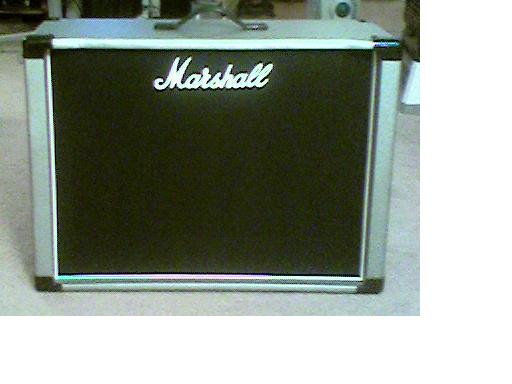
Hey Howie, I just got some Dacron looking stuff from a local fabric store by the yard ($4.00 yd). It looks like about an inch thick, white and fluffy. You can almost see thru it. I saw something like it in a Bogner cab stapled to the inside of the back panel. I have been working on this old Peavey 2x12 Chorus shell that I converted into a 2x12 cab complete with "Marshall" logo! ;D ;D It isn't deep at all (only 10") but I sealed it, put on some silver Tolex, black grill cloth w/piping and now I'm gonna fill it with insulation. I'm first gonna test it with nothing, then apply the one inch padding and then fill it with the thicker stuff. I'll let you know what happened. Planning on this weekend....
cgtrox 8-)
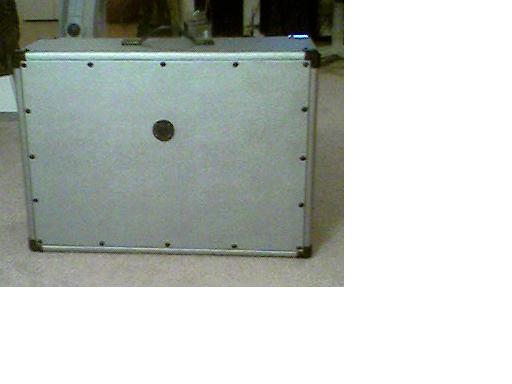
Here's the back of it, complete w/Speakon connector...
sweet Chris. Let me know how you like it. I still haven't found any sheets of the stuff. Have to go looking when I get feeling better.
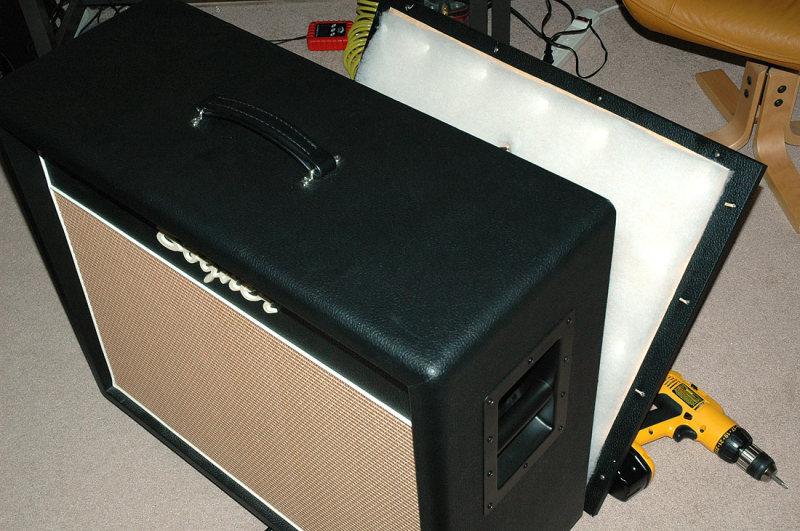
I found it at a fabric store, I think a crafts store might have it, too. It looks exactly like this stuff in the Bogner cab. Here is the Bogner cab pic...
cgtrox 8-)
I'll have to hit up a couple of the crafts stores.
Also, for those playing along at home, verification that Bogner uses it. ;)
does the actual type of fill material matter?
I suppose it does in some way.. but could you staple towels to the inner walls of the box for the same effect? or is there something beyond damping going on?
Yeah, if anything works, I've got an extra roll of this I could use! ;D

That is actually what you CAN use Craig! Just good ol fashioned fiberglass house insulation. I had a Peavey monitor that was filled to the brim with it and it sounded good. But, they make an equivalent that doesn't have fiberglass. Like Dar said above, by filling a cab with insulation, you are taking the "cab" out of the equation and are just hearing the drivers. In a sealed cab, you take out the battle that the back sound waves are having with themselves. Thus, the driver gets to shine! It's supposed to make a small cab sound bigger. The way Bogner uses it is to "fine tune" the cab. That's why I am going to do it piece by piece. I'm gonna start with nothing, then add the back piece, then add the stuffing. Like I said, I will post the findings here...
cgtrox 8-)
Sheep,
not to get too nutty audiophile or anything ;), but yes it matters what you use. The acoustic properties of wool and dacron are far superior to say a cotton towel. You can (I may have alluded to this above) actually TUNE a cabs bass response by the amount (by weight) and form (sheet, loose stuffing, or rolls of it) that you put in a cab. That's exactly what is done in home speakers. In guitar cabs it's "generally" only used to tame the back wave reflection, which is audible when when it hits the cone (and much more prominent in shallower cabs).
I have a program called "bass box pro" courtesy of a friend here :-X that allows you to tune box size to driver parameters and tune speaker response accordingly. The insulation goes a level past that allows further A) simple damping of reflections or B) tuning of lower mids and bottom end.
interesting
I figured a thin cotton towel would be less effective, but is it the material itself that makes the difference?
ie, could you use cotton batting material instead of dacron (matching it's thickness) or are cotton fibers intrinsically poor in this application?
using cotton here just for the purpose of example.
I think it's the way the material is "presented" to the cab. A towel, while made of cotton, is more tight, matted and less porous. I've read where some guys use cotton batting. The stuff that Bogner uses (and that I got) is more fluffed to catch the sound waves. The pink or yellow house insulatuion is even MORE fluffed, I've actually seen it inside home stereo speakers and my Alesis studio monitors. Open your studio monitors and check it.... ;)
cgtrox 8-)
yeah Sheep, it's not the cotton per say. If you found cotton that was unwound fiber like this stuff, it would work. Woven fabrics lose a good deal of their acoustic absorbing properties.
ahh, ok.
thanks for the explanations! little things like that can drive me crazy until I understand what's going on.. heh.
cgtrox — Feb 25, 2009That is actually what you CAN use Craig! Just good ol fashioned fiberglass house insulation. I had a Peavey monitor that was filled to the brim with it and it sounded good. But, they make an equivalent that doesn't have fiberglass. Like Dar said above, by filling a cab with insulation, you are taking the "cab" out of the equation and are just hearing the drivers. In a sealed cab, you take out the battle that the back sound waves are having with themselves. Thus, the driver gets to shine! It's supposed to make a small cab sound bigger. The way Bogner uses it is to "fine tune" the cab. That's why I am going to do it piece by piece. I'm gonna start with nothing, then add the back piece, then add the stuffing. Like I said, I will post the findings here...
cgtrox 8-)
Interesting. Naturally, I'd prefer to use something without the fibreglass.
Next question. All of the cabs I would do this application to are Avatar's (three 1x12's and one 2x12) which have an open back in about the middle third of each cab. Needless to say, that just means the sound waves have to travel a short bit farther before hitting the wall and reflecting so wouldn't these also benefit from the insulation (including covering the open area)?
Finally: Do you HAVE to staple the stuff in there or could I just make a thick square the width and height of the inside back panel and feed it in through the opening on the back?
From what I'm understanding here, this insulation only needs to be at the back of the cab (am I correct?) and, since it's purpose is to dampen the reflections, it doesn't need to be completely flat across the back (i.e., it could be slightly curved around the driver).
If all of the above is accurate, then you (in theory) could simply have some of these pre-cut squares in various thicknesses and just put one in the back of a cab whenever you wanted to dampen a cab.
Next question. All of the cabs I would do this application to are Avatar's (three 1x12's and one 2x12) which have an open back in about the middle third of each cab. Needless to say, that just means the sound waves have to travel a short bit farther before hitting the wall and reflecting so wouldn't these also benefit from the insulation (including covering the open area)?
I'd cover the back that's there, not the hole. Unless your open back cab (and the avatars open back has a smallish opening) sits right against the wall, once exiting the cab, the waves are diffused enough to not really come back into the cab with enough strength to be heard on the cone. Again, unless you have the cab backed right up to the wall. IF you do, I'd throw a Sonex or similar panel behind the opening instead of covering the hole.
Finally: Do you HAVE to staple the stuff in there or could I just make a thick square the width and height of the inside back panel and feed it in through the opening on the back?
Stapling is only a method of attaching it so it stays uniform on the cab back. Some use velcro, some glue (permanant). Just stuffing it on the hole won't make it COVER the back.
From what I'm understanding here, this insulation only needs to be at the back of the cab (am I correct?) and, since it's purpose is to dampen the reflections, it doesn't need to be completely flat across the back (i.e., it could be slightly curved around the driver).
No to the first question. You CAN put it on sides, top and bottom or you can even go a level past that and "stuff" the cab. The premise over covering the back is the most common these days, because the primary goal is to stop the reflection off the back from hitting the cone and being audible. If all you do is cover the back, you'll see just how audible that backwave is. And yes, you could just put it around the speaker. Tacking it to the back is just neater and leaves access to speaker, wires etc without moving insulation.
If all of the above is accurate, then you (in theory) could simply have some of these pre-cut squares in various thicknesses and just put one in the back of a cab whenever you wanted to dampen a cab.
Absolutely. In fact it's not a bad idea. One at at TGP had 1-2 and 3"thick precut sheets for one of his cabs. Depending on what speaker was in it, and what tone he was going for at the time, he use the one he liked best for that task.
One guy had an open back combo with speakers he loved but tubby bass. I covered the back, sides and bottom, and said it was better. Dropped in a couple little "rolls" in the bottom/back junction and said it's the best ever. The Roll functioning as a bass trap. But normally the biggest gains (or differences anyway) are in closed back cabs. Taken to the "nth" degree, if you have a recording ISO cab, you'd probably want to STUFF the mic side after tuning the back side. You want the acoustic allusion of the mic in open space room, not a closed box. That means you want that side as damped as possible. If the boxes are equal size on both sides of the driver, that also makes their acoustic size "different" which is preferable.
DreamTheaterRules — Feb 25, 2009 Finally: Do you HAVE to staple the stuff in there or could I just make a thick square the width and height of the inside back panel and feed it in through the opening on the back?
Stapling is only a method of attaching it so it stays uniform on the cab back. Some use velcro, some glue (permanant). Just stuffing it on the hole won't make it COVER the back.
For the record, I didn't say "on" the hole, I said "in" the hole. In other words, putting the insulation inside the cab not just covering the hole on the back.
I think it only works for closed back cabs... :-? :-/
cgtrox 8-)
So putting the insulation over that third-size hole won't help? Would you also have to make a wood insert as well or is that even possible?
(Needless to say I wouldn't do that, heck I'm too lazy to staple the insulation in! ;) )
Chris,
Depends on what results you are after and the cab design. I can name at least 3-4 highly regarded boutique amp/cab makers who use it on various designs of open back cabs.
Craig,
The idea of simply covering the back with insulation has one goal. To stop the back wave from audibly slapping back on the cone. Covering the opening WILL change the sound in the room, as it will damp some of the highs that normally go out the back and create the spacious sound that open back cabs have. But unless your cab is practically touching the wall, that's all it would do. (Anyone with a rear port stereo system speaker, should listen to this...)
I have one open back cab in my music room. It has a piece of foam behind it because it's a small room and its close to the wall. In a bigger room with it moved out a foot or more, I wouldn't do that. But mine sits 4" from the wall so I try to diffuse the back wave sound a bit. But that's an "in the room" effect, not "in the cab" effect.
So, (going over this once again), if I were to put the insulation inside the cab via the port on the back so that it sort-of cups the driver/cone and/or sort-of covers the entire inside of the back, I could get the desired result, yes?
Also, my cabs are currently in a pyramid with two of the 1x12's on the bottom (not touching each other), the 2x12 in the middle and the final 1x12 on top. These are all acoustically separated using Aurelex Gramma pads right now and most of the speakers are something different. At least for now, the pyramid is about 4" away from the wall so I would have that issue if I kept them like that. Here's what they're loaded with:
Bottom two 1x12's: Celestion G12M Greenbacks - 25w - 8 ohm (originally used for stereo)
2x12: Celestion Vintage 30 - 60w - 8 ohm
2x12: Celestion G12H30 70th Year Anniversary Special - 30w - 8 ohm
Top 1x12: Celestion Alnico Blue - 15w - 8 ohm
I also have a pair of ADA Slant stacks loaded with Hellatone's in the same configuration as the 2x12 above (same two speakers, just aged).
The original goal was to have a bunch of cabs with different speakers so you weren't loading and reloading whenever you wanted something different (the 2x12 was the first cab I bought from Avatar so that was before this strategy and before I had to reload the ADA's after one of the G12S' blew). I used to also have two 2x12's with G12H80 Specials (similar to the speaker Line 6 put into their Vetta cabs), but those have been sold along with my G-Flex 2x12 loaded with the same.
Now I'm thinking I might sell parts of this, though which parts are is still up in the air (the ADA's would, unfortunately, probably be the first to go since I don't play live with friends anymore :( ).
Anyway, being able to add the insulation could give me more options with whichever cabs I end up with which is why I'm asking all these dang questions! ;)
(Plus it CAN'T be that expensive! :) )
Hey Howie, I can see how that would still work as the waves are still hitting the back panel.
So, to recap. Basically, if you put a 1" slab of Dacron type insulation on the back panel it will kill the backlash. If you fill it with insulation, it will isolate the drivers and make a small cab sound bigger.
That is all. :-X
cgtrox 8-)
So get some of this, eh? :)

Craig 1= yes, you can diffuse the backwave with it loosely tucked around the driver, rather than tacked to the back.
Chris= yep, you've got it! When you pack it in, it starts to make the cab acoustically bigger. Now, this is a double edge sword. The bottom end will extend and be cleaner (yes, just like it was in a bigger cab, which is why monitors and smaller stereo speakers almost always have it if sealed) but if it tames a particular resonance that you like, you may HEAR more bass without it. (In closed back cabs) but the bass will be tighter with it.
Craig 2= that would make a nice bass trap, but only if you take the plastic wrap off! ;)
Craig 3= that's a nice bunch of speakers you have there!
Hey guys, I really didn't have the time to "experiment" with the insulation like I wanted to. I did staple a square to the back panel just like the Bogner cab, then I just stuffed the rest in there. It is a very shallow cab (only 10") but it sounds so big! The bass is very tight and the palm mutes rock! The cleans are nice and round, too. I'll try it without the extra stuffing in there and get back to ya. I was just in a hurry with a lot of "honey-do"s.
cgtrox 8-)
great update. Just what I expected. Remember, the more you pack in there, the more the effect. (And, that there can be too much of a good thing here. At some point, for some, more might not be better). I'll probably start (If I can ever find the freakin stuff!) with the back panel covered. Then add some loosely in the cab. I probably won't "stuff" (push enough in to start to compress it) until later. However, the smaller and especially thinner that you cab is, the more this can help. If' anyone has got a cab where the magnet practically touches the back of the cab, I'd consider packing some in right away to see what you think. Obviously it's working so far for Chris.
I didn't actually stuff it in there. It was more like laying in there kinda loose like. I'm gonna pull out that and try it with just the back on there.
cgtrox 8-)
Cool experiment guys. Keep us up to date on how you find different things work out.
I'm interested because I'll be building a 2X12 to go with the two new amp heads/kits I'm looking at.
I just hope I can get somewhere close to Chris's head/cab build quality wise.
The funny thing is that I've pretty much decided what I want to build (a 5watt single ended recording head, a 10/20/40 watt 2 channel gigging head and a common 2x12 (probably loaded with V30's or a single V30 and something else for recording purposes) for use with both heads). The cab will end up being a compromise between what sounds good live and what sounds good with a mic shoved in front of it.
Lots of negative comments about Greenbacks here lately. My first choice for a mixed speaker combo would have been a V30/Greenback but with some of the comments here that Greenbacks sound "wooly", I'm not so sure now. :-/
spud — Mar 09, 2009 Lots of negative comments about Greenbacks here lately. My first choice for a mixed speaker combo would have been a V30/Greenback but with some of the comments here that Greenbacks sound "wooly", I'm not so sure now. :-/
If they sounded "wooly" I might have to keep mine! ;D
No, Greenbacks sound "woo
dy" not wooly. ;)
I will never again be without a greenback of variant thereof. I currently have the Greenback. Private Jack (clone but with more lower mids and twice the power handling) and the Wizard (a G12H copy). For those of you who don't know, a G12H is like a Greenback, but with a much bigger magnet. My Wizard handles 75 watts.
I'm going to sell the Greenback because it's worth the most money and the Private Jack sounds at least as good. The Wizard is currently my favorite of the three though.
The Wizard is my next purchase after an A/B switcher.
cgtrox 8-)
I love my Wizard, and the G12H's I've heard. Chase had some in one of his cabs that sounded great.
Well, I'm not going to get rid of my Greenbacks (or at least not both). When I sell the Avatar 2x12 I'll reload it with my older G12S' that originally came out of my ADA Slant Stacks.
Well I have added some to my amp. I can't say that I've had it in long enough to hear a major difference....but then again I have an open back amp that I thought was perhaps a little more closed than it really is. I was under the impression that teh back bottom covered more of the speakers than I thought. I can definately tell it's tightened the bass up. But I'm not sure if it's a bit too stiff now. Though I agree on palm muted stuff....different.
what did you use? I went looking again today and did not find what I wanted. I found polyester fill, but it was at Hobby Lobby and it was EXPENSIVE! I want dacron polyfill if I can find it.
Went to Walmart and got bag of high loft polyester batting. Which look exactly like what you guys are talking about. It was back in the chick hobby section.
That stuff will work FB. Although, I have to tell you guys....
We had a gig on Friday, I went for the sound check around 7pm, I thought I was gonna be in tonal heaven, WRONG! My new cab didn't sound right at "gig" level. Maybe it was the new preamp? I'm not sure, I really haven't had a chance to experiment with it like I wanted to. I only tried it at "apartment" levels before the gig. I wanted to try it with the V30 by itself, too.
It was weird, it sounded kinda sterile, and it was only on some settings. The clean stuff sounded good, and some of the high gain sounded great! The palm muting chunk was there, so I took it home and disconnected the V30. It was good enough for the gig. I need to try some things before the next one.
Howie, you think having too much of that stuff will hinder the cab? I think I'll try it with just the pad stapled to the back panel. Maybe the cab needs to "breathe" a little? Or do I just need to "tune" it? I don't know..... :-/
cgtrox >:(
I don't even have this stuff attached in the back. I basically cut a piece that wrapped from one side to the other. So it's just on the sides and the back. I am going to throw a piece in the bottom and see what happens. BUt this stuff I got is thick enough I didn't even have to staple it or glue it. It just stays in place.
I've played mine at gig levels (though I live in a house....WTF I like it loud). I'd say that the difference I hear is marginal. It's there but I don't think it's a huge difference. I've played a lot more with it on the distortion sound. I need to dedicate sometime to the clean channel.