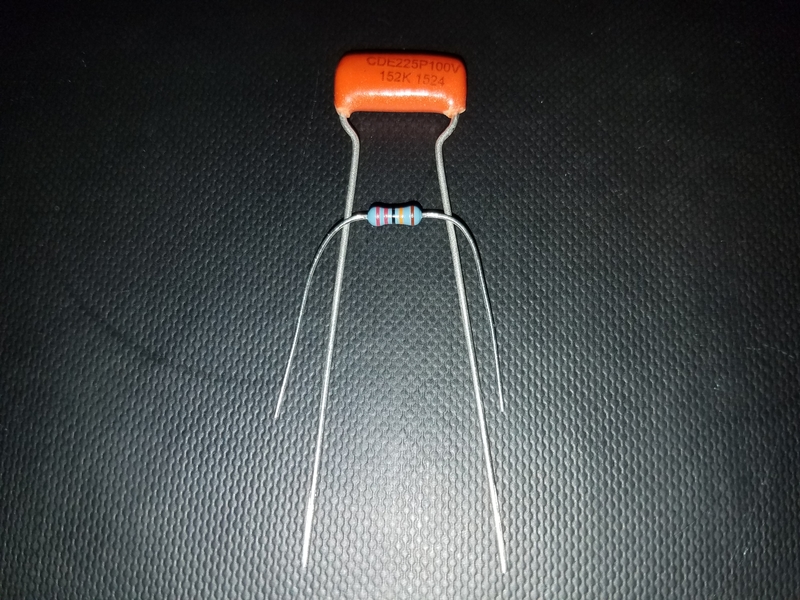
Treble Bleed Mod for Guitar Volume Pot. Does anybody have any experience with the mod? What capacitor and resistor values did you land on?
I bought several different capacitors and resistors to try different configurations. I did a bunch of reading on the subject and think I have a fair understanding of what I need to do.
I was just curious if you guys had any experience to pass along. Thanks!
Jon_G#2 · Jan 21, 2017 08:52 UTC
Watch this series of 4 videos. This guy is really good at showing some great ways to do this, the best in my opinion is the master pot approach in one of the videos
https://youtu.be/Z8-tTDzVQls
DM#3 · Jan 21, 2017 13:56 UTC
Thanks for that, Jon. That very much clears up much of what I had read. I had bought .001Mf, .0015Mf, & .002Mf and resistors 130k, 150k, 220k & 330k. I bought 2 of each because I have 2 guitars. The first with 500K pots.
Seymour Duncan uses a .002Mf and most other that I read about uses a .001MF. So I bought a few different to try. In most of my reading, it was suggested that half of the pot value was a good place to start with the resistor value.
I'll look at those other videos too. Thanks again! :)
Jon_G#4 · Jan 21, 2017 18:43 UTC
The biggest improvement is by taking the output of the volume pot from the middle lug instead of the outside lug. The video on master pots explains this in detail with some really good sound examples.
I need to do this to my epiphone les Paul as the "jimmy page" wiring with all the push pull pots make it impossible to turn down the volume without losing huge amounts of treble which makes it unusable "live" unless I use a volume pedal, which I do, so I will be swapping over the output lugs soon and see what that does. Be sure to post some examples once you have done yours
This is the video that I find particularly interesting and useful
https://youtu.be/NzYwuYG1Ls0
DM#5 · Jan 21, 2017 19:36 UTC
The bits, as you guys say, won't be in until Wednesday. I'm going to tackle my Gibson L6S first. Same in that when you roll the volume back it just goes to shit.
I have an Epi Nighthawk that has the push pull splits. I want to do the same to it, but I also want to do some upgrading to the switch and pots as well. In some of the reading I did, a suggestion was to use a "trim pot" for the resistor, then you can dial in the most likable tone for your guitar.
Jon_G#6 · Jan 21, 2017 21:05 UTC
I've tried many treble bleed formulations on the jimmy page wiring and none of them work at all. I wasted a lot of time trying to get that to work but it just doesn't, but by changing it to dependent master volumes that should work but it's a bit of a fucker getting the wiring harness out to do it. I was actually thinking of putting it back to humbuckers only so removing all the push pull stuff and then go with dependent master wiring to maintain the treble when rolling down the volume.
DM#7 · Jan 21, 2017 21:46 UTC
I watched that video on Indi Vs Master volumes. That whole thing got kind of muddy for me, but I kind of follow having some experience with Les Paul wiring. I have an old LP copy that my Mom gave me forever ago. I have tinkered with pickup changes and wiring fuck-ups. LOL ;D
I read where someone else had some issues with the treble bleed mod on a circuit with push-pulls.
I'm limited on my Gibson. One volume, one tone. I think the treble bleed is the best option for that one. The Epi may be an entirely different animal.
ironsheep#8 · Jan 22, 2017 03:02 UTC
Can't help with anything other than "I totally hate that mod". My PRS had it from the factory... took it off. Tried it on some other guitars... it just sucks! Maybe there's a magic ohm value and cap pair that would work for me... but honestly, warming up the tone is the reason I use the volume knob in the first place so... to hell with that mod. heh.
Sorry, not helpful, I know. ;) ;D
DM#9 · Jan 22, 2017 14:31 UTC
Hey, I may find that it won't work for me either. Thanks for your input. I'm curious what PRS component values are. The mod the way that I understand it, shouldn't change your tone when on 10. That should be a given, mod or not. The mod should help to retain the highs as you roll off the volume. So that it doesn't turn to mush after about 8. I am looking to clean up a lead tone to a playable sound without having to switch to an entirely different sound, channel, pedal. Good Lead tone, roll it off to a good cleaner tone.
There are a lot that use the mod with success. There are no specifics other than every guitar is different. If nothing else, I'll gain some knowledge about it.
ironsheep#10 · Jan 22, 2017 15:10 UTC
Definitely experiment! It's super easy to do and you might like what it does... Timmons uses it, it's stock on all Suhr guitars afaik, etc.
In effect, I use the tone control(s) for this - volume at 10, I'll roll off some treble with the tone control and set the amp/pedals/stuff fairly bright... rolling back the volume, I can add some treble with the tone control if needed. Rarely needed though, I kinda like a dark clean(er) tone - sounds more distant and relaxed to me... which is how I generally use clean(er) sounds anyway.
I never bothered to find the right resistor for my particular pot, I guess. Without a resistor (just a cap), it's an icepick factory... but adding the resistor changes the pot a little too - finding the right grouping of resistor/pot and capacitor would probably be worthwhile... but I gave up on it years ago.
Aaaaaand, now I'm thinking of trying it again... lol.
DM#11 · Jan 23, 2017 00:25 UTC
Something you might try is the trimpot method. The resistor comes in the form of an adjustable pot. Once soldered in you can use a little screwdriver to adjust the value.
I'll try to record my starting point and then my trials. Hey, this stuff keeps me off the streets. LOL! ;D
Here is one article I glanced at that mentions some different methods.
Alan Ratcliffe - Articles: Electric Guitar Volume Pots 2: Treble Bleed Mods http://www.ratcliffe.co.za/articles/volumepot2.shtml
charger#12 · Jan 23, 2017 21:50 UTC
The best "treble bleed" mod is a volume pedal. Other than that, physics is completely going to screw you. Impedance + tiny tiny AC currents from your pickups means it's a losing battle.
DM#13 · Jan 24, 2017 01:05 UTC
I do not doubt your electrical expertise. But, :P since I have the components coming on Wednesday, I'm gonna give 'er a whirl.
If I can get just a little improvement in the volume pot use @ below 5, I'd be happy.
I've never explored a volume pedal. Do you run it right after the guitar? Does it clean up in the same way as the guitar volume? Guitar electronics are screwy as the chain changes.
Edit: I watched this video and it helped clear up some Volume pedal questions.
That Pedal Show Where do you put your volume pedal? - YouTube https://www.youtube.com/watch?v=4SQ-G75_pk0&list=PLlXYVdnj0ogd8jOFF12mmfLSUF4dhFEH5&index=6
Jon_G#14 · Jan 24, 2017 16:36 UTC
As I mentioned in an earlier post I always use a volume pedal purely because of this problem. Guitar straight into passive volume pedal and thereafter into effect/amp etc. It's great, you don't lose any treble at all. The other thing that I have done sometimes is house a volume pot in a small box with in and out sockets and clip that onto my strap so I can then control the overall guitar volume from a strap mounted pot, this works very well too as it is in effect a volume pedal in a box on your strap. The other thing that is worth trying (which I haven't done yet but will work just fine, is sacrifice one of your tone pots and make that into a master volume pot after the other volume pots on the guitar as that will then be in effect a volume pedal mounted in the guitar. I will probably do it this way as I never need both tone pots on my les paul, never had any need to use both at same time so just have one tone pot that covers both pickups.
DM#15 · Jan 25, 2017 01:12 UTC
Ok, my caps and resistors arrived today, so here is a starting point sound.
Just the Bassbreaker 007 > 8" Celestion 815 Gain 9 o clock, B, M , T, @ Noon, Master @ 3 o clock
I'm partial to a Dm chord. ;D The guitar is a '75 Gibson L6S , SD '59 Neck pickup
I was surprised that the lower settings were audible in the recording. Volume @ 10, > 8, > 6, >4, >2, >0
🎵 Volume_Starting_Point.mp3
DM#16 · Jan 25, 2017 01:45 UTC
Here are the first culprits. Most recommend a 1000pf, SD recommends a 2000pf cap. I'm starting with a 1500pf Orange Drop cap. Being a 500K pot I'm going with a 220K resistor to start. About half the pot value is recommended. When I solder these in, I will use a gator clip aluminum heat sink to protect the parts, as recommended.
DM#17 · Jan 25, 2017 03:30 UTC
Well, Definitely different. Immediate change was it let more volume from the pickups through. I had to drop my record levels. Pushes the amp more. little cab rattled some. Much better travel on the volume knob. Works down to about 2 then drops off. More volume but a little darker. That may not be a bad thing. There were times that I thought it too bright before. Also the tone knob is different now. Still works, but more subtle. Maybe a cap change there. I can't remember what size cap I had on the tone.
I'll play it for a bit to see.
Here's a similar test. I used smaller incremnts on the roll back up.
🎵 1500pf220k.mp3
ironsheep#18 · Jan 26, 2017 13:35 UTC
More volume is interesting... can't think of why that would be.
Sounds good to me!
DM#19 · Jan 26, 2017 14:47 UTC
It was odd. After playing around some last night, it seems my previous "10" is now about "8". So I gained volume and and it cleans all the way down to about "2". Much better overall.
I was able to get the tone pot closer to previous status by switching out the tone cap from a .022mf to a .05mf. Most Gibson schematics use a .047mf for dual coil pups. I had a single coil in there a long time ago. That is probably where the .022mf came from. So, now it's closer to where it should be.
I'm going to leave as is for a bit to see how I like it. Once I get bored, I may try some of the other cap / resistor combos that I have to see the changes.
For info purposes, I soldered the cap /resistor in parallel. Some variations have the mod in series.
charger#20 · Jan 30, 2017 20:14 UTC
Maybe I'm going deaf... it sounds like the mod is making your sound *darker* as you turn down? Is that the intent? I always thought the idea was to not lose treble as you turned down. Also, I'd love to hear what you mean by parallel/series. The two do radically different things. I am assuming you are wiring from the wiper to ground, e.g. 2 to 3 on the volume pot? Sorry I'm way too lazy to read the articles...
charger#21 · Jan 30, 2017 20:39 UTC
First things first, why parallel? If I'm thinking this through, parallelling 250K (half the pot) and 220K means you have dropped your resistance between those poles to 117K. Then you add 1.5n of capacitance, which makes an LPF around 1000Hz. That's pretty high, and pretty dark. You'd want that to function as a HPF as you turned the pot down, and be centered lower.
So, pay attention to the interaction between values... there is a big difference between the recommended values (100K/2n) and what you are using (220k/1.5n). That difference equates to about 300Hz. To get the values recommended by someone like Kinman, you'd use a smaller cap. 100K/2n = 796Hz 220K/1.5n = 482Hz
220K/1n = 723Hz 220K/910pf = 795Hz
Also, when you run the elements in series, remember, cap > resistor > ground is an HPF (I assume this is what you want). Resistor > cap > ground is a LPF.
ironsheep#22 · Jan 31, 2017 04:00 UTC
I was wondering if the higher output might be from the fresh/improved soldering... then I read the article:
"My preference is for a series resistor as I do not like the change in volume taper."
Could be why it seems different... though I'm still unsure how it could actually be louder with the same but now effectively lower ohm pot. Darker, sure... but louder at full volume... weird. still a bit mystified.
wouldn't a cap and resistor in parallel wind up like a lower ohm pot with a cap and no resistor... but with a different taper? physics was a long time ago... lol.
The article has it wired from input to wiper - rather than wiper to ground.
but, most likely, I will just continue to use lower output pickups with some combination of machine/fuzz/boost/fuzz/od... in series. ;)
DM#23 · Jan 31, 2017 12:47 UTC
I appreciate you weighing in, Charger. I know you are knowledgeable about these things. I am not. I read two articles. One said use 1000pf, One said use 2000pf. I started in the middle. Zero electronic reasoning. A simple guess.
With your values of substance, it gives me more to work with.
It may be a little darker, but to me it seems that I have about the same sounds as previous between 8 and 4. The knob is fairly effective betwwen 10 and 2, so it does clean more as you turn down. Meaning with a stomp overdrive on 10, Crunch, on 3 with the same overdrive, defined chording.
So, overall, the volume control is more effective, which is what I was after.
I did see in some reading, cap values like .068, which comes closer to your values. I may have to spend another $2.00 for more trial pieces. One article mentioned resistor values of 330k. A lot of wide ranges.
Sheep, I have no answer for the more volume, it just is. I'm not so sure it is that great. In some instances, it seems to overload, so I roll back.
I have played with it some. I'm still undecided whether I like it more. In some instance yes, others maybe not. It's minor stuff either way.
Edit: I have it wired like your first example, Sheep. Bleed6
ironsheep#24 · Jan 31, 2017 14:21 UTC
sorry for the continued perplexity about the volume DM, I don't mean to sound like I'm demanding an explanation -- it's just one of those little things that piques the interest and can't be shaken! heh :)
DM#25 · Jan 31, 2017 17:57 UTC
I didn't take it as a demand, only as curiosity. But if it were a demand, I'd still have no clue. ;D
charger#26 · Jan 31, 2017 20:15 UTC
You cannot add volume to guitar pickups with passive components... this would violate several immutable laws of physics.
Adding resistance, in this case, reduces the overall resistance... because parallel resistances reduce. (1/rT=1/r1+1/r2). This increases low frequencies (or more accurately, attenuates low frequencies LESS). Increasing low frequencies (attenuating low frequencies LESS) makes the guitar output "louder".
DM#27 · Jan 31, 2017 20:55 UTC
That explains it in a way I can get my head around. I read something to that effect, but couldn't grasp it.
So, I think my example is retaining the treble that it kept as the pot is turned down and the Mod is performing as it should. It's just not more treble.
How do I measure the resistance of the pickups alone? Then try to match that resitance with the added mod, so that the mod performs as it does, yet retains most of the original pickup sound?
I like the performance of the volume knob. But I get that my values are off. Explains why in some instances that above 8 can be muddy.
charger#28 · Jan 31, 2017 22:20 UTC
I would try wiring it in series, lug_x > resistor > cap > lug_y, then lug_x > cap > resistor > lug_y. I'd also try a 1n/1000pf/.001 cap, and .91n/910pf/.0091 cap, if you stick with the 220K resistor.
To make it easier, buy a bunch of caps/resistors and prewire them then just solder in in one order, then the other. You can save yourself a bunch of money if you don't use Orange Drops, they look nice, but aren't necessary; audio doesn't pass through the caps. Ceramic caps and decent film or polyprop caps are going to be more accurate, too (orange drops are 10%). I'd use ceramics because I have them in these values and they are smaller... Here are some prices for film caps/resistors, not much more expensive than ceramics when you buy in quantities this small. The 910pf film cap is a little more expensive because it's an unusual value. If you want me to throw together the combinations to try out and mail them to you (with ceramic caps) I can.
220K xicon 1/4w 1% resistors ($.15) - http://www.mouser.com/ProductDetail/Xicon/271-220K-RC 1000pf WIMA 5% film cap 630v ($.55) - http://www.mouser.com/ProductDetail/WIMA/MKP1J011002C00JSSD 910pf Vishay 5% film cap 630v ($1.27) - http://www.mouser.com/ProductDetail/Vishay/BFC237510911
charger#29 · Jan 31, 2017 22:32 UTC
Pickup resistance is fairly easy to measure, take the pickup hot and ground lead and measure with a multimeter. It will be something between say 3K and 20K. 20K would be very hot, 3K very mellow. But what you really want to do is measure L, inductance, which is not easy... http://www.syscompdesign.com/assets/images/appnotes/guitar-pickups.pdf
DM#30 · Feb 01, 2017 04:25 UTC
Thanks for that. I'll read up on that link you posted.
I have some 1/4 watt resistors 220k, 330k, 150k, 130k. The lower values for if I try this on another guitar with 250k pots.
I have a couple 1000pf Caps. I would have to get the 910pf from mouser. I appreciate the offer to send them. I used mouser to get the ones that I have. They are pretty easy to deal with so I can get them there.
I want learn a little more about measuring the values, so I can try to keep it close to what the pickup is supposed to put out.
I'll try your suggestions. It'll take a bit before I can get to it. I just picked up a few bigger jobs, so my fuck-off time has dwindled.
DM#31 · Feb 02, 2017 02:08 UTC
I had a little time this evening after work, so I put in the 1000pf cap/ 220k resistor that I had. I liked the way the volume knob worked so I thought I'd try parallel first.
Before I pulled out the other mod, I went to the Seymour Duncan website and looked up the given resistance for the two pickups that I have.
Then I measured my actual pickups. (pretty easy PAF type single hot / shield ground)
Bridge - 8.5 Neck - 7.74
Close, but a little more than given on the web. Then I measured through the circuit with the mod using a guitar cable tip / ring - knobs on 10.
1500pf220k Bridge - 8.25 Neck - 7.4
Then I removed the Mod and measured the tip/ring
Without mod Bridge - 8.33 Neck - 7.58
Then I added the new Mod
1000pf220k Bridge - 8.33 Neck - 7.58
The exact fucking numbers, I shit you not. Question, do you think if I add the 910pf220k Mod it will bring it closer to the actual measured resistance value of the pickups.
The new mod definitely brought back some treble and clarity. I recorded a sample, but it can't be compared to the others. I was fucking around the other day and put my 1 x 12 back in my iso cab, and added a different mic. This one also has an Angry Andy OD and a smidge of delay.
🎵 1000pf220k.mp3
Jon_G#32 · Feb 03, 2017 19:49 UTC
Sounds workable to me
DM#33 · Feb 04, 2017 12:50 UTC
Thanks for the listen, Jon. I actually like it much better. I played it some and think it's good. I think it's close to what the intended mod should be. I do want to try the other mod that Charger mentioned with a 910pf Cap in series. I need to get the parts. I'm in no real hurry. It's more just a curious learning experience. The current mod is more than adequate for my needs.
I am curious about the same resistance measurements with the newer mod. I'm guessing that it brings the mod to a value that is not added resistance. So the measurement is the total of the pickups plus the two pots. The new mod just alters the taper and the passage of frequencies without adding resistance to the pot. A guess, and I guess that is why to measure the Inductance, but that is Way past me.
akatomcox#34 · Feb 04, 2017 14:47 UTC
Thanks for taking the time to share your work DM.
I just put a set of Alnico II Pros in my goldtop and so far so good - I like the neck pickup better than the bridge but I like the bridge way more than the 500T that was in there. I like to set up my amp to get a clean I like on the neck pu with tone and volume maxed and then roll the bridge tone back to take out any harshness on the same settings. Lower volume mellows the tone even more and maxed adds back some bite for leads. Volume and tone adjustments both change the tone slightly - can be a good thing for me. I will probably keep this one like it is.
I might play around with this mod in my LP Studio though.
ironsheep#35 · Feb 04, 2017 20:01 UTC
the last clip there is a good example of what I was getting at about not liking this mod... where the highs are still there at lower volume. thin, plinky and brittle compared to the full on tone. It's a tonal state that runs counter to my whole sense of what I want things to sound like! heh, it's personal I guess. Not a sound I like at all from a guitar... but it's just my preference.
just one of those things. Rock on!
DM#36 · Feb 05, 2017 13:56 UTC
I here ya Sheep. I think I still like the improved knob performance better. Maybe Charger's other suggestions will help bring it closer to original tone and keep the improved knob performance.
Tobe, I had just switched out the 500T on this guitar with the the '59 Bridge. The 500T just didn't match up with the '59 Neck. I tend to like the neck pickup better too.
charger#37 · Feb 06, 2017 22:17 UTC
Yeah, makes sense measuring with the volume knob full up. In that scenario there should be really no difference (which is what you get) between modded and unmodded. The added resistance you are getting looks like 250 Ohms when you go through the input jack. That loss is from the volume pot. A volume pot is a resistor with a wiper that makes the resistance between two poles some size, based on the physiscal material. Imagine though that the pot is wide open... even wide open, there is some sliver of conductive material between the wiper and the outer lug (if there wasn't, the electrical connection would break). You're getting 250 ohms from that sliver of conductivity, which is .05% of the pot value, not bad.
When the treble bleed is engaged, but the volume pot is on full, the circuit should be exactly the same in terms of resistance--the treble bleed should be out of circuit, and begin rolling off lows as you lower the pot. None of this explains why your guitar was subjectively louder at full volume with the previous mod... but I'm guessing if you measured the results would be the same.
DM#38 · Feb 06, 2017 23:22 UTC
I thought that you had explained the volume increase in that the added resistance from the 1500pf cap increased the lows to bump the volume. (adlib) The measured resistance on the 1500 mod was lower, meaning increased resistance. That is how I took your explanation of it.
Here's your quote.
Adding resistance, in this case, reduces the overall resistance... because parallel resistances reduce. (1/rT=1/r1+1/r2). This increases low frequencies (or more accurately, attenuates low frequencies LESS). Increasing low frequencies (attenuating low frequencies LESS) makes the guitar output "louder".
Here's the measured mods again.
1500pf220k Bridge - 8.25 Neck - 7.4
Then I removed the Mod and measured the tip/ring
Without mod Bridge - 8.33 Neck - 7.58
Then I added the new Mod
1000pf220k Bridge - 8.33 Neck - 7.58
So, it was more resistance before I changed the Mod.
charger#39 · Feb 07, 2017 20:45 UTC
Yes, I see that, but capacitance isn't resistance. You can add as much capacitance as you want and the resistance shouldn't change (there is ESR, which is tiny amounts of resistance that capacitors have, but it's negligible, in the range of about 3 ohms for an orange drop). The "perceived" volume will change with the change in bass content, but the resistance won't. So I guess that works. As for the difference in measurements between the mods, it's not much, is it?
The weirdest number in that is the first number, where with one mod you have a slightly different resistance than you do with no mod/2nd mod. I can't say I understand it. I've definitely gotten readings with that amount of variation based on the temperature of the piece (something recently soldered vs cold), but I'd want to see that measurement come out with the difference more than once to consider it reliable... only because it doesn't really make much sense...
DM#40 · Feb 08, 2017 00:01 UTC
Does the 1500pf cap change the way the 220K resistor works? In that configuration, can it allow more resistance? I don't know. I only perceived that the lower resistance measurement explained the volume bump from your statement.
I took the measurements a few times. The meter jumps around a bit, so I tried to be consistant in the way that I measured each time and took the reading several times to be sure I was getting the closest reading.
I do think it odd that the last two measurements, without the mod and with the newest mod were exactly the same. I thought I had fucked up the solder job.
When I get around to trying the 910pf and 220k in series (both directions) I'll measure those as well. I just thought the numbers would be more matter of fact. I think it's interesting the changes in attenuation in each application.
I think the mod works as it should. It's just trial and error to find the right configuration for your setup.
charger#41 · Feb 08, 2017 21:48 UTC
The cap shouldn't change the resistance. Things that change resistance are basically resistors and long lengths of wire. A cap has ESR, but like I said it's a tiny amount.
In the end, if it sounds good, it is, which is the easiest measurement of all.